Highlights
Back in 2018, I published a post here at Family Studies exploring the effect of premarital sex partners on marital happiness: Does having more prior sex partners lead to a less happy marriage?
Perhaps grandiosely, I started the post with a potted history of American (hetero)sexual behavior. There really had been only one major change in American’s sexual behavior over the past century: the 1960s. Plenty of people had premarital sex before the 1960s, but most of these young lovers eventually tied the knot (“most” became “almost all” in the case of pregnancy). After the 1960s, it became more common to have a couple of sexual liaisons that didn’t culminate in marriage. The body counts were highest for Generation Xers, but tailed off a bit for subsequent generations, especially for men. In recent years, we started hearing about the sex recession. Meanwhile, the marriage rate has experienced an unprecedented decline over the past few decades.
An exogenous shock is what social scientists call a consequential event that occurs outside the system of relationships you’re trying to explain. For most of us, the Coronavirus pandemic will be the exogenous shock of our lifetimes—and a good justification to revisit past social science findings. It’s reason enough for me to revisit my post on premarital sex and marital happiness.
In another IFS post, I wrote about trends in celibacy through 2022. While the overall effect of the pandemic wasn’t substantial, that wasn’t the story for everyone. Young women ages 18-29 had much less sex during 2021, but rebounded the year after.1 Young men, always greater risk takers, didn’t have any less sex that year. Any extended spell of celibacy matters for young adults, because it’s when a lot of people will meet their future spouses. The marriage rate predictably fell during COVID but then rebounded to pre-pandemic levels. Perhaps this reflected the pent-up demand of betrothed couples delaying their nuptials until the pandemic abated.
Sex Partners and Marital Happiness
All told, these changes seem like blips rather than trends. What about the relationship between sex partners and marital happiness? Back in 2018, I examined General Social Survey (GSS) data collected between 1989 and 2016. For the uninitiated, the GSS is an annual or biennial cross-section of Americans surveyed since 1972. Consistent with the word General, the GSS is an omnibus survey with a wide range of questions. Unfortunately, the items on lifetime sexual behavior were only administered between 1989 and 2022. Are survey items of sexual behavior accurate? I’ve put these data through their paces and cross checked, and the answer to this question is they are pretty good.
How has American’s lifetime sexual behavior changed since 2016? Figure 1 shows how sexual behavior—specifically, lifetime body counts—changed for married adults before and after 2018. The figure contrasts the data I analyzed in my 2018 IFS post, with the newer data presented here.2
The broad trend is straightforward: over time, fewer married people reported one lifetime partner, while more reported what I’ll call promiscuity-lite, between two and 10 partners.3 Higher levels of promiscuity remain relatively uncommon. As I reported elsewhere for IFS, high promiscuity is more common for men than for women, but it has been increasing for women and decreasing for men.
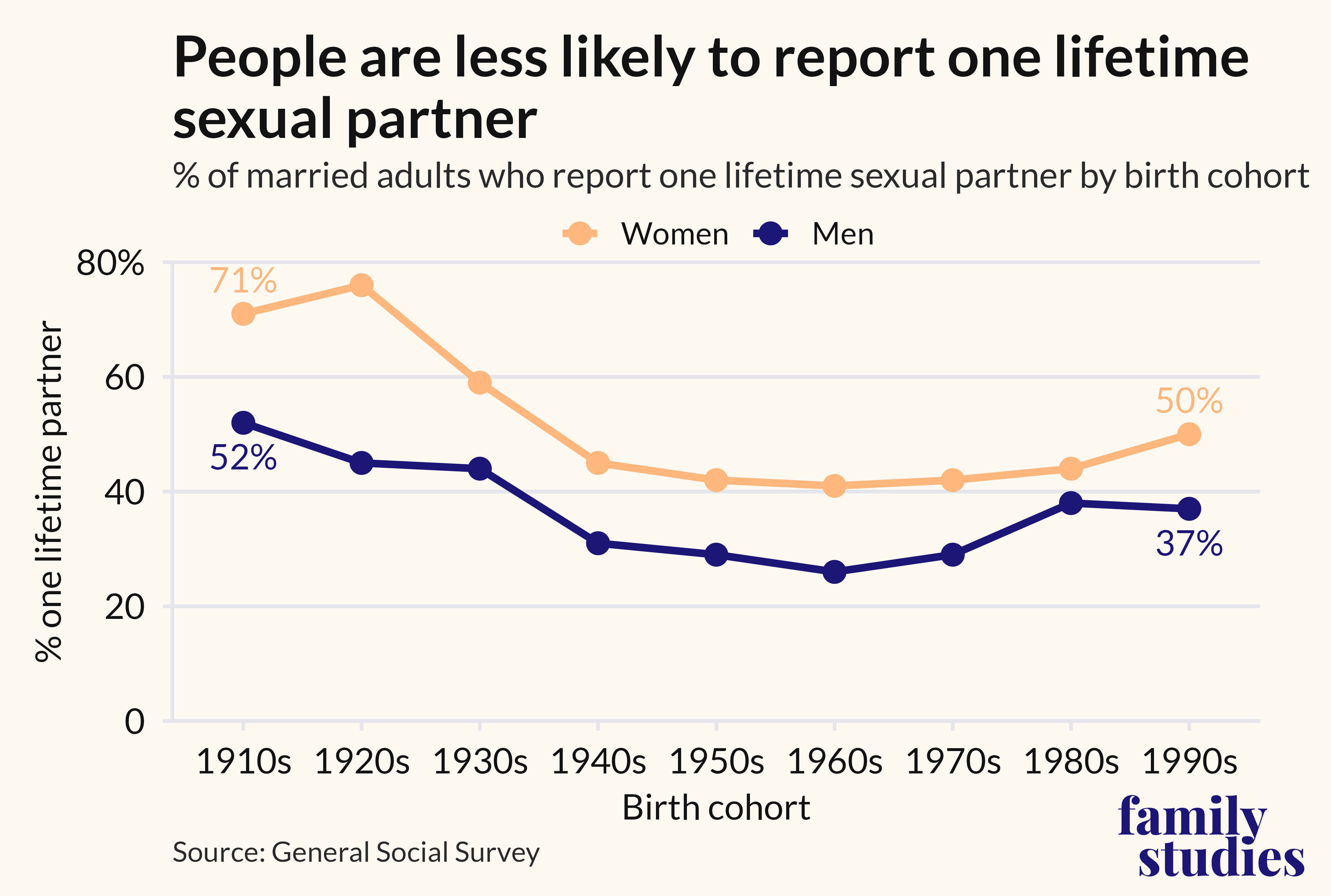
With promiscuity-lite being the new reality, has the relationship between premarital partners and marital satisfaction changed? I see two possibilities. The first is that things are the same as they were with the 1989-2016 data, where marital satisfaction had an inverse relationship with body counts. This hypothesis requires selective statis, where nothing changed except people’s premarital sexual behavior. But that seems improbable given all the long-term changes to the family. The marriage rate has fallen but so has the divorce rate. Marriages have become happier in recent years, perhaps because only happier couples are choosing to tie the knot. What’s more, we’re now over 50 years removed from the Sexual Revolution, and these years haven’t seen major changes in American’s sexual behavior. The other possibility is that promiscuity-lite—and perhaps any promiscuity—just doesn’t matter as much as it used to when it comes to marital happiness. We might think of this as the Covid hypothesis, because it required the exogenous shock of the pandemic to bring about.
High promiscuity is more common for men than for women, but it has been increasing for women and decreasing for men.
The data appear to support my hypothesis. The figures below show the relationship between lifetime sexual partners and the percentage of respondents who describe their marriages as “very happy.” Survey respondents, both male and female, with only one lifetime partner are about as happy in more recent years (2018-2022) as they were for previous years. But that’s where the similarities end.
For the earlier data, there had been a notable decline, especially for men, in very happy marriages for people with more than a single lifetime partner. Now having anywhere up to around five partners may have fewer adverse effects on marital quality for both sexes. In fact, men with two lifetime partners are now a couple of percentage points more likely to report a very happy marriage than are their one-partner peers.
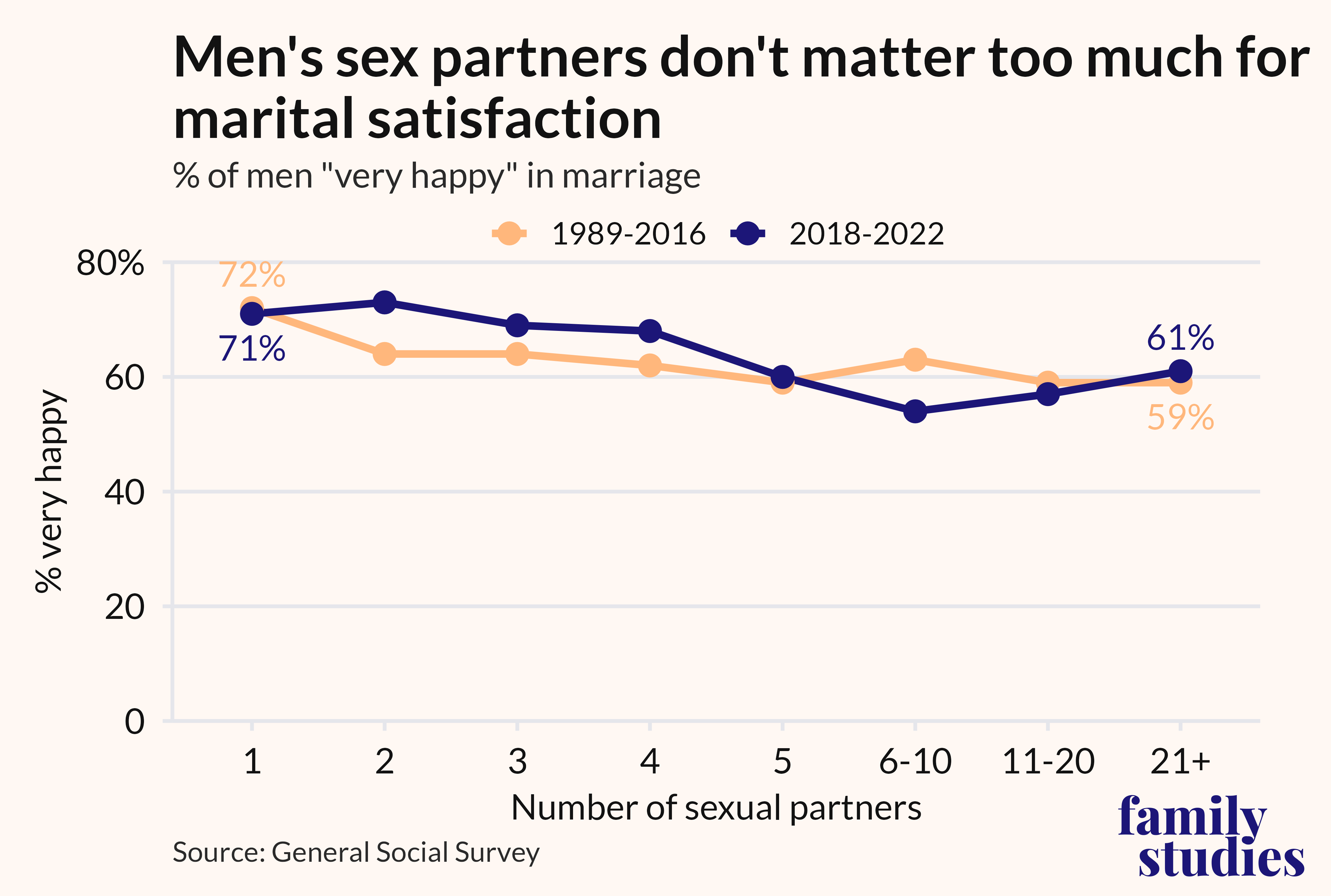
The same is true for women who report two or three partners. Premarital sex partners don’t appear to reduce marital quality until the body count rises above four or five. At that point, the 2018-2022 data come to resemble the older data, revealing a negative association between premarital promiscuity with marital happiness. At 5 partners (for men) or 6-10 partners (for women), marital quality is around 10 percentage points lower than it is for their contemporaries who were less sexually active prior to marriage. For men, the percentage of very happy marriages rebounds slightly for the most promiscuous men but remains notably lower than the comparable figure for men who were less sexually adventurous prior to marriage.
There’s no such rebound for women: the percentage of female survey respondents in very happy marriages declines steadily for women with more than five premarital partners—and then falls off a cliff for the 2% of women with over 20 lifetime partners. Just 38% of these women report their marriages are very happy.
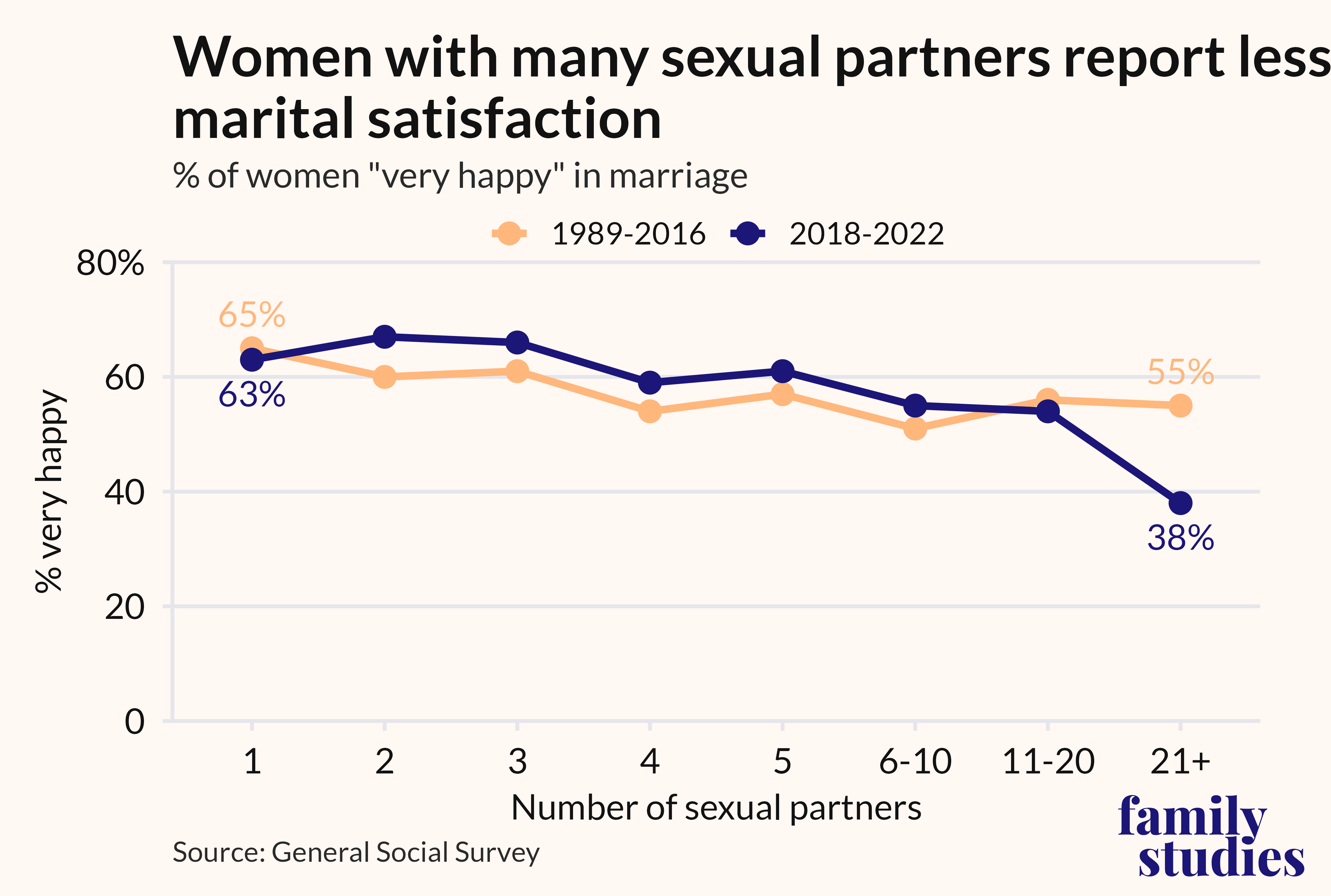
This is a new development. There’s no such precipitous decline in marital happiness for the most promiscuous women in the earlier data, spanning 1989 to 2016. In those data, promiscuity never produced a drop in marital happiness that exceeded 13 percentage points.
We should treat these finding as provisional given the sample sizes. It’s beyond dispute that marital happiness continues be lower for people with a lot of premarital partners, but the foregoing trends may or may not persist. The decline in happiness for women with over 20 partners is based on 192 respondents, and the difference in marital happiness between 1989-2016 and 2018-2022 is only marginally significant (p = .05). Consequently, larger samples and more years of data are necessary to determine whether the differences between the 1989-2016 data and the 2018-2022 data are signal or noise.
Back in 2018, I subjected these data to multivariate analysis, to see if various measured differences between respondents could explain the relationship between premarital promiscuity and marital quality. In successive regression models, I controlled for a personal history of divorce, socioeconomic status (income, education), and religiosity (denomination, frequency of attendance). This was essentially a bust: none of these socio-demographic differences between respondents had much effect on the relationship between premarital sex and marital happiness.
I repeated this analysis for the recent GSS data and found the same thing (see Table 2). None of the measured differences between respondents had much of an effect on the relationship between premarital sex partners and marital happiness. The measures of religiosity—denomination and attendance—together were good for a few percentage points of happiness for women (but not men). The logic here seems clear enough: pious women have fewer partners and happier marriages (Brad Wilcox and I found the same thing in our 2016 book Soul Mates: Religion, Sex, Love, and Marriage among African Americans and Latinos). Otherwise, there does not appear to be much going on here. A personal history of divorce (i.e., being in a second, third, or fourth marriage) and socioeconomic status cannot explain the relationship between sexual biography and marital quality.
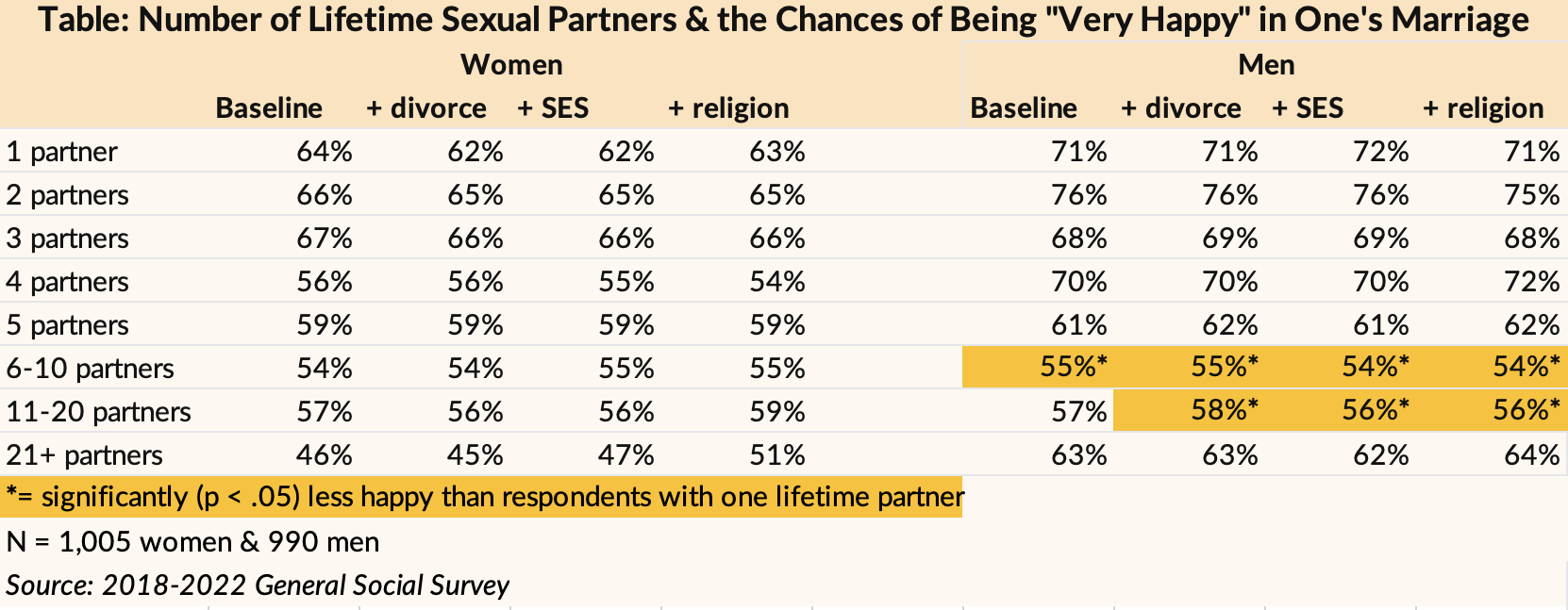
It’s also worth noting that few of the percentages shown in the table represent statistically significant differences from having just one partner. The shaded cells in the table represent the cases in which having more than one partner significantly reduces the chances of being in a “very happy” marriage. Only men who have 6-10 partners and 11-20 partners (except in the baseline model) report significantly fewer “very happy” marriages compared to men with just one partner. For these men, the effect is reasonably large: about 55% of these men say their marriages are very happy, compared to about 71% of the men with just one partner.
Otherwise, the table suggests little evidence of reduced marital happiness corresponding to many partners. The differences are in the expected direction, but they just aren’t statistically significant. This includes the much lower rates of very happy marriages (46-51%) reported by women with 21 or more partners. Presumably a larger sample size would make this difference statistically significant, but the same can’t be said for the 62%-64% of men with 21+ partners who’re very happy in their marriages—they’re notably happier than their peers with 6-20 lifetime partners.
Key Takeaways
Compared to what I reported in 2018, what is the same and what has changed?
Having a lot of premarital partners still reduces marital quality, but promiscuity-lite doesn’t seem to make much of a difference for most people. People with several premarital partners don’t report any less happiness than people who wed having had one (or zero) lifetime sex partners.
There are more eye-raising findings at the extremes—for the small number of highly promiscuous (21+ partners) Americans. Promiscuous women report far less happy marriages than anyone else in this sample, while very promiscuous men are more likely to have happy marriages than their slightly less promiscuous contemporaries. But we shouldn’t place too much stock in these results, because the samples are small and promiscuous adults are always a rarified population.
Most people think of death and taxes as life’s inevitabilities. Social scientists might add cohort replacement to that list. Older people are dying, and being replaced by younger people with different attitudes, beliefs, and experiences. The GSS is a sample of adults. This means the average respondent is in his or her 40s, but they’re flanked by teenagers and octogenarians (the GSS top-codes age at 89). So, the sample I analyzed in 2018, drawing on data collected between 1989 and 2016, contains Americans born at the ends of both the 19th and 20th centuries—and thus a number of respondents who came of age before the sexual revolution. By 2018, this population has been almost entirely replaced by respondents who grew up in different sexual and marital circumstances. This process accelerated during the pandemic years, with COVID disproportionately lethal to the elderly.
So, cohort replacement may be changing the relationship between sex and marriage. In the old days, any number of premarital partners incrementally decreased marital quality. Now it’s common for newlyweds to have more sexual experience, so it may no longer figure in marital quality as much as it once did. But readers should keep in mind that the differences between the earlier data and the newer data are all fairly small and may not be borne out in a larger sample. For this reason, it makes sense to update these findings in another eight years.
Nicholas H. Wolfinger is Professor of Family and Consumer Studies and Adjunct Professor of Sociology at the University of Utah. His most recent book is Professors Speak Out: The Truth about Campus Investigations (Academica Press, 2025).
Editor's Note: The opinions expressed in this article are those of the author and do not necessarily represent the views, policies, or positions of the Institute for Family Studies.
*Photo credit: Shutterstock
1. Not surprisingly, most ongoing surveys skipped 2020, the first year of the pandemic. I think it’s safe to say that far fewer Americans had sex that year.
2. For obvious reasons, the GSS wasn’t fielded in 2020. And 2018 wasn’t a pandemic year, but my earlier analysis ended with the 2016 data. The inclusion here isn’t making a huge difference: if I only look at the 2021-2022 data, the results look pretty similar to those I report here.
3. I realize “promiscuity” is a relative term. Some benchmarks per my previous analysis: top-5% promiscuity is 16 partners for women, and 50 partners per men.