Highlights
The latest U.S. birth data confirm that the long-running decline in fertility is continuing. The general fertility rate in 2025 was 53.1 births per 1,000 women ages 15–44—a remarkable 23% decline from its 2007 level of 69.5 (Hamilton, 2026). Much of the public discussion asks which group of women is driving this trend—working-class women facing economic constraints (as highlighted in Tavernise and Adelson, 2026) or highly-educated women pursuing professional success (as profiled in Smith, 2022). This research brief shows that this framing is misguided. The decline in fertility is not concentrated in any one group. Instead, it is broad-based, with strikingly similar trends across women with and without a college degree.
We track fertility and marriage patterns across recent generations of women, separately by education level. The data reveal a striking result: although levels differ between education groups, the trends are very similar. Across all cohorts examined—women born in the 1970s, 1980s, and 1990s—college-educated women, on average, have fewer children, are more likely to be childless, and are more likely to be married at all observed ages. However, the changes in these outcomes have been roughly proportionate across groups.
[T]he decline in fertility in the United States is not a story about one group of women delaying or foregoing childbearing. It is a broad, population-wide shift that cuts across educational lines...
In other words, fertility is lower and childlessness is higher among young women today than among women of the same age 10 to 15 years ago, regardless of educational attainment. These patterns cast doubt on claims that the fertility decline is driven primarily by one socioeconomic group. Instead, the evidence points to a broad, cohort-wide shift away from early marriage and childbearing among today’s young adults. Understanding this broad-based shift is essential for interpreting the causes of fertility decline and for designing effective policy responses.
Cohort-specific Fertility and Marriage Profiles, by Education Level
We use data from the June supplements of the Current Population Survey (CPS) from 1995 through 2024 to examine fertility and marriage outcomes among women ages 25 to 45. Women are categorized by education level as of age 25 and grouped into four birth cohorts: 1975–1979, 1980–1984, 1985–1989, and 1990–1994. For each cohort, we present outcomes through the oldest observed age in the data. Note that this approach takes educational attainment of a cohort as given, and as such, does not consider the role that increasing college attainment has played in decreasing fertility.1
Children Ever Born
Figure 1 displays the average number of children a woman has had by age, separately by cohort and education level. Panel A presents results for women without a four-year college degree, and Panel B presents results for women with a college degree.
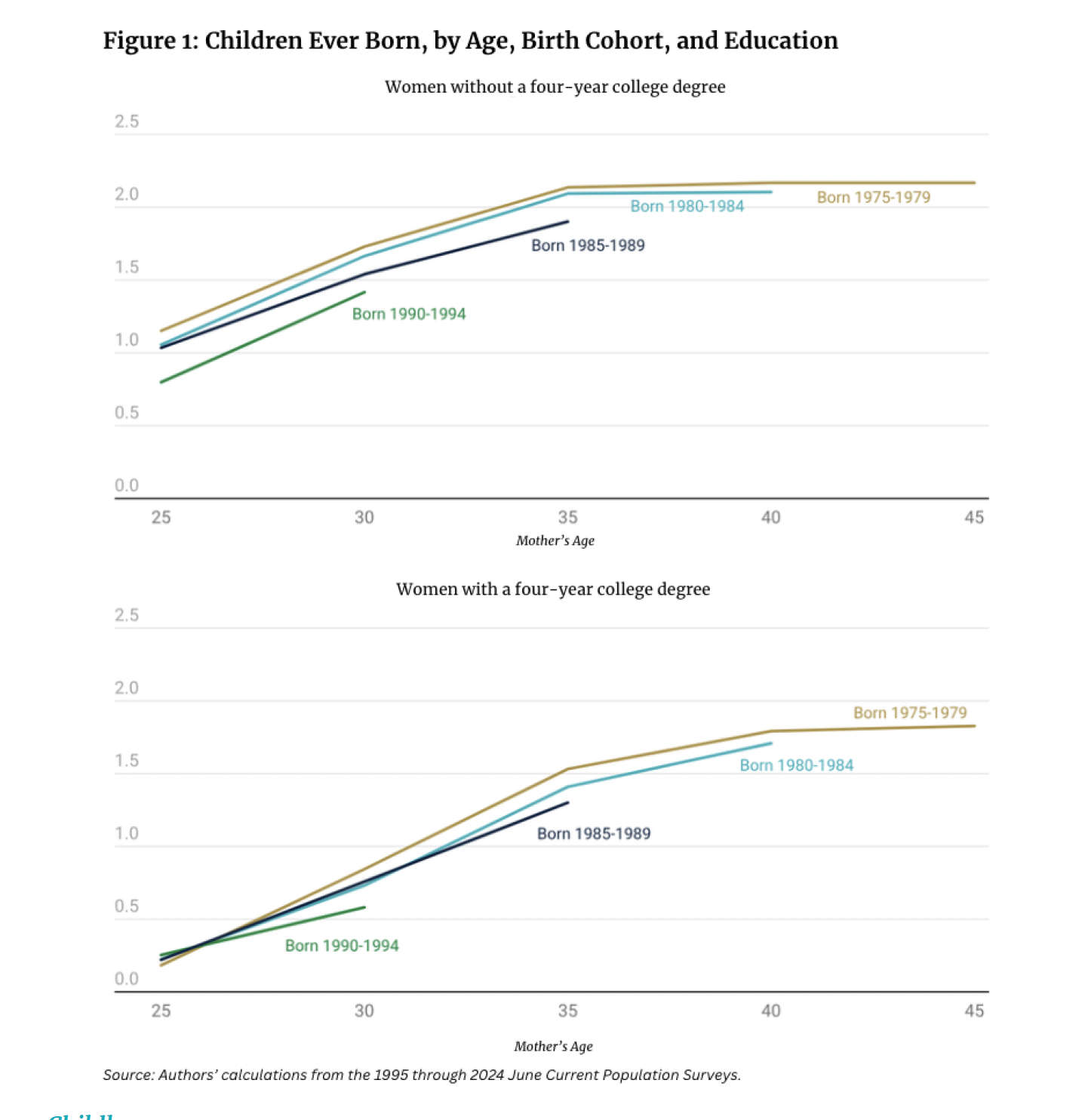
Consistent with longstanding patterns, college educated women have fewer children at every age within each cohort. For example, among women born between 1975 and 1979, those without a college degree had an average of 2.17 children by age 45, compared to 1.83 children among college-educated women. Among women born between 1980 and 1984, completed fertility by age 40 was 2.10 for non college-educated women and 1.71 for college educated women.
More notable, however, are the changes across cohorts. Fertility by ages 30 and 35 has declined substantially in both education groups. Between the 1975–1979 and 1990–1994 cohorts, average fertility at age 30 fell from 1.72 to 1.42 children among women without a college degree (a 17 percent decline) and from 0.84 to 0.58 among college-educated women (a 31 percent decline). Similarly, between the 1975–1979 and 1985–1989 cohorts, completed fertility at age 35 declined from 2.14 to1.90 among women without a college degree (a 11.2 percent decline) and from 1.53 to 1.30 among college-educated women (a 15.0 percent decline).
Childlessness
Figure 2 presents age-specific rates of childlessness by cohort and education. The patterns mirror those for fertility: childlessness has increased across cohorts for both education groups.
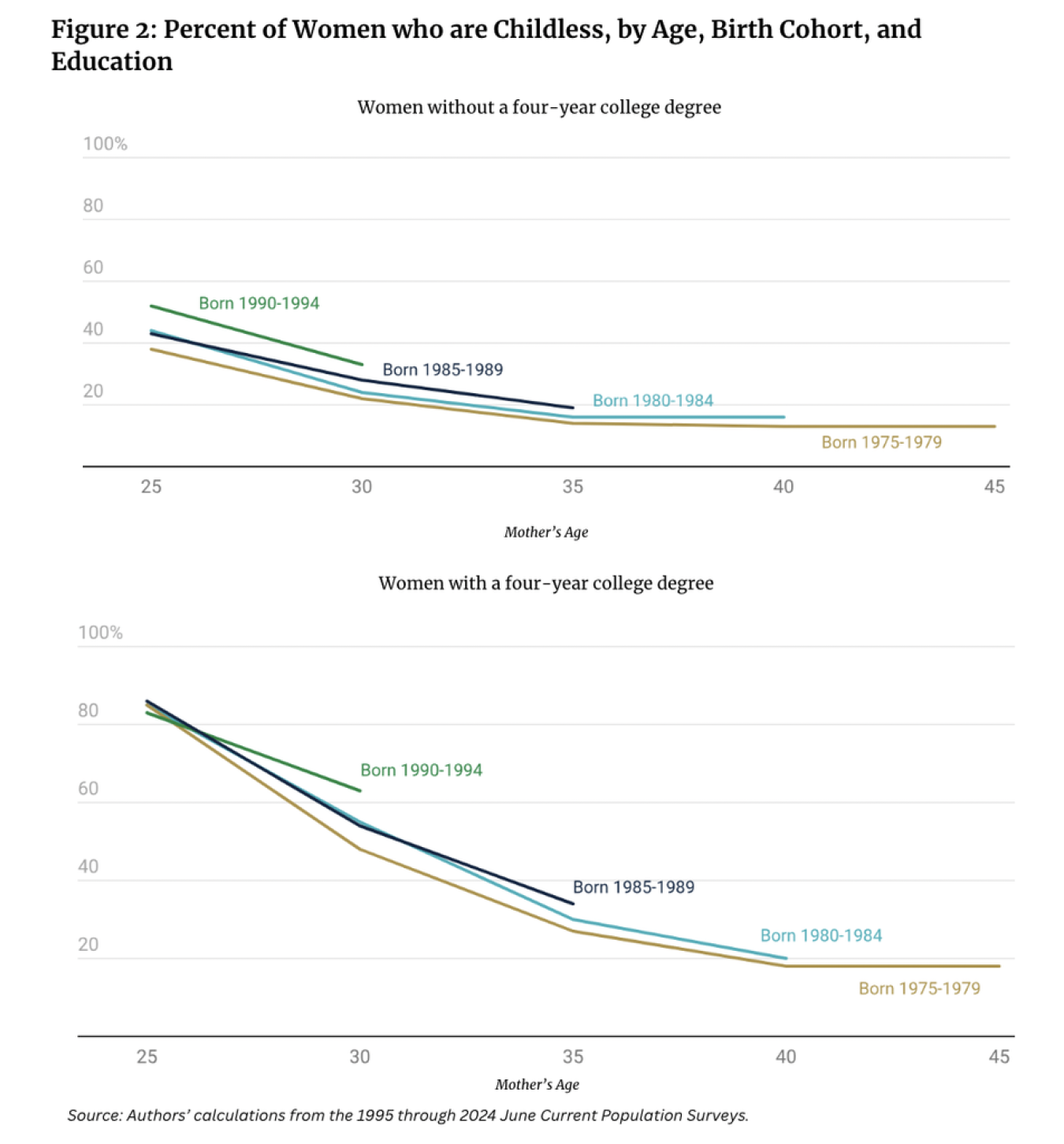
Comparing the 1975–1979 and 1990–1994 cohorts, the share of women who were childless at age 30 rose from 22% to 33% among those without a college degree (a 50% increase), and from 48% to 63% among college-educated women (a 31% increase). Similarly, between the 1975–1979 and 1985–1989 cohorts, childlessness at age 35 rose from 14.3% to 19.3% among non-college-educated women (a 35.0 percent increase) and from 27.0% to 34.4% among college-educated women (a 27.4 percent increase).
Marriage
Figure 3 displays the share of women who have never been married by age, cohort, and education level. Again, the patterns are consistent across groups: rates of “never married” have increased substantially for both college-educated and non-college-educated women.
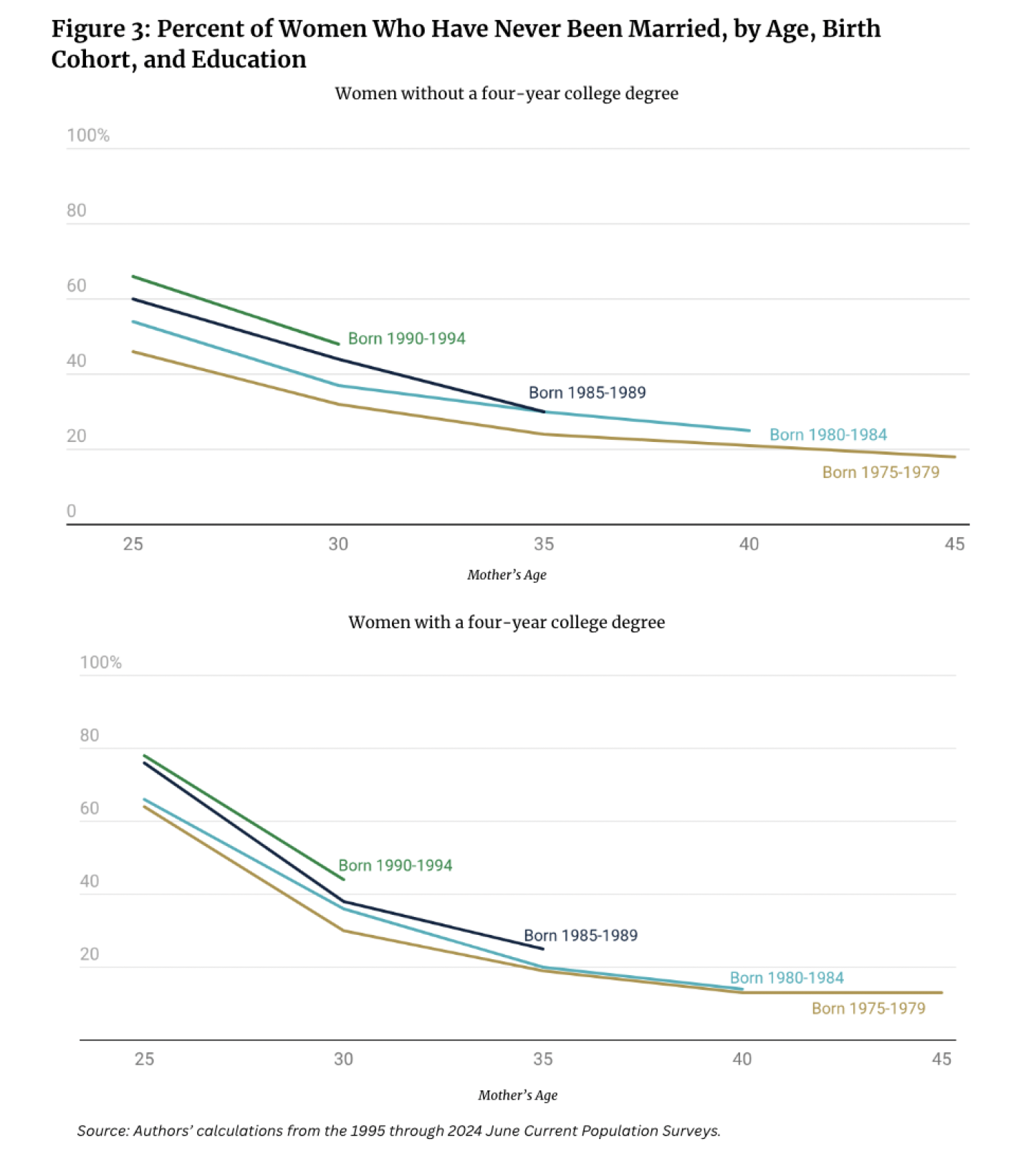
Between the 1975–1979 and 1990–1994 cohorts, the share of women never married at age 30 rose from 32 percent to 48 percent among those without a college degree (a 50 percent increase) and from 30 percent to 44 percent among those with a college degree (a 47 percent increase). Betweenthe 1975–1979 and 1985–1989 cohorts, the share never married at age 35 rose from 23.8% to 29.7% among non-college educated women (a 24.8 percent increase) and from 19.2% to 24.5% among college-educated women (a 27.6 percent increase).
Final Discussion
Taken together, these results point to a clear conclusion: young adults today are having fewer children, are more likely to remain childless, and are less likely to be married by ages 30 and 35 than women of the same age in earlier cohorts. Importantly, these declines have occurred at similar rates for women with and without a four-year college degree. This finding is central for interpreting the broader fertility decline. It suggests that the decline is not primarily driven by changes within a particular socioeconomic group. Instead, the data are more consistent with a broad-based, cohort-wide shift in behavior and priorities.
One interpretation—consistent with our prior work (see Kearney and Levine, forthcoming)—is that younger cohorts are placing relatively less emphasis on early family formation and parenthood. This may reflect a range of underlying forces, including changing social norms, evolving expectations about careers and relationships, increased uncertainty in the economic and social environment, and shifts in how young adults evaluate the timing and desirability of marriage and children.
In short, the decline in fertility in the United States is not a story about one group of women delaying or foregoing childbearing. It is a broad, population-wide shift that cuts across educational lines, reflecting deep changes in how young adults are organizing their lives and making decisions about family formation.
Editor’s Note: This article was original published by the Strengthening Families Research Initiative at the University of Notre Dame. It has been reprinted with permission. The full research brief is available here.
1. From 1993 to 2023, the share of young women ages 25 to 34 with at least a four-year college degree rose from 23% to 47%. (Pew Research, 2024.)