
Highlights
- Social media, gambling, and porn...are enervating, at odds with other valuable goods in life, including relationships, and yet another cause and effect of demoralization. Post This
- The constant use of media is, in part, a coping mechanism against demoralization, but one that also contributes to it. Post This
Of all the themes in the public discourse around young men, none have received as much coverage as their heavy screen use, and none have been portrayed as having more dire consequences. In gaming and on social media, many have argued, young men are being incited to drop out of society, adopt aggressive, even violent behavior, objectify women, and flout social norms. In Part I, Chapter 3 of our two-part report, we briefly considered the potential influence of the “manosphere” and reported that young men in our survey appear to be less taken with it and its image of manhood than pundits claim. But those were the only questions we asked that related to media messages. While it is not our contention that such messages are inconsequential, we are of the view—with some research justification—that the amount of time that young men play video games or gamble or watch pornography is far more significant than social media consumption (where the great majority of influencers are women). With electronic media, we used our limited questions on screentime.
We address this issue last in our latest report because we place it among the responses to stressful circumstances. The predicament that young men find themselves in has been building for a long time. It did not emerge with electronic media but, as we have suggested, with more complex social changes that have made the world less stable and less certain, where the opportunity structure for men has changed dramatically, where goods like the American Dream, participation in a community, likelihood of marriage, and the work-reward nexus can no longer be taken for granted. A sense of isolation and alienation, and of having—as we put it in the survey—“little control over the things that happen to me” has followed on these changes. In this sense, the constant use of media is, in part, a coping mechanism against demoralization, but one that also contributes to it, as we will see.
In the survey, we asked young men how often they engaged in any of eight activities, from using social media to streaming videos to trading on the stock market. The six-option response scale ranged from “almost constantly,” to “about once a day,” to “never.” In Part 2 of our report, we focus on four of the activities: using social media, gambling (including making bets on sports and other events, but not stocks), watching pornography, and playing video games. In terms of frequency, young men engage with each of these practices at very high rates—which, of course, overlap, as young people have many platforms and screens running at the same time. After considering the numbers, we will turn to an analysis of how the high rates of these practices correlate with negative outcomes, especially feeling lonely and like a failure.
Social Media Use
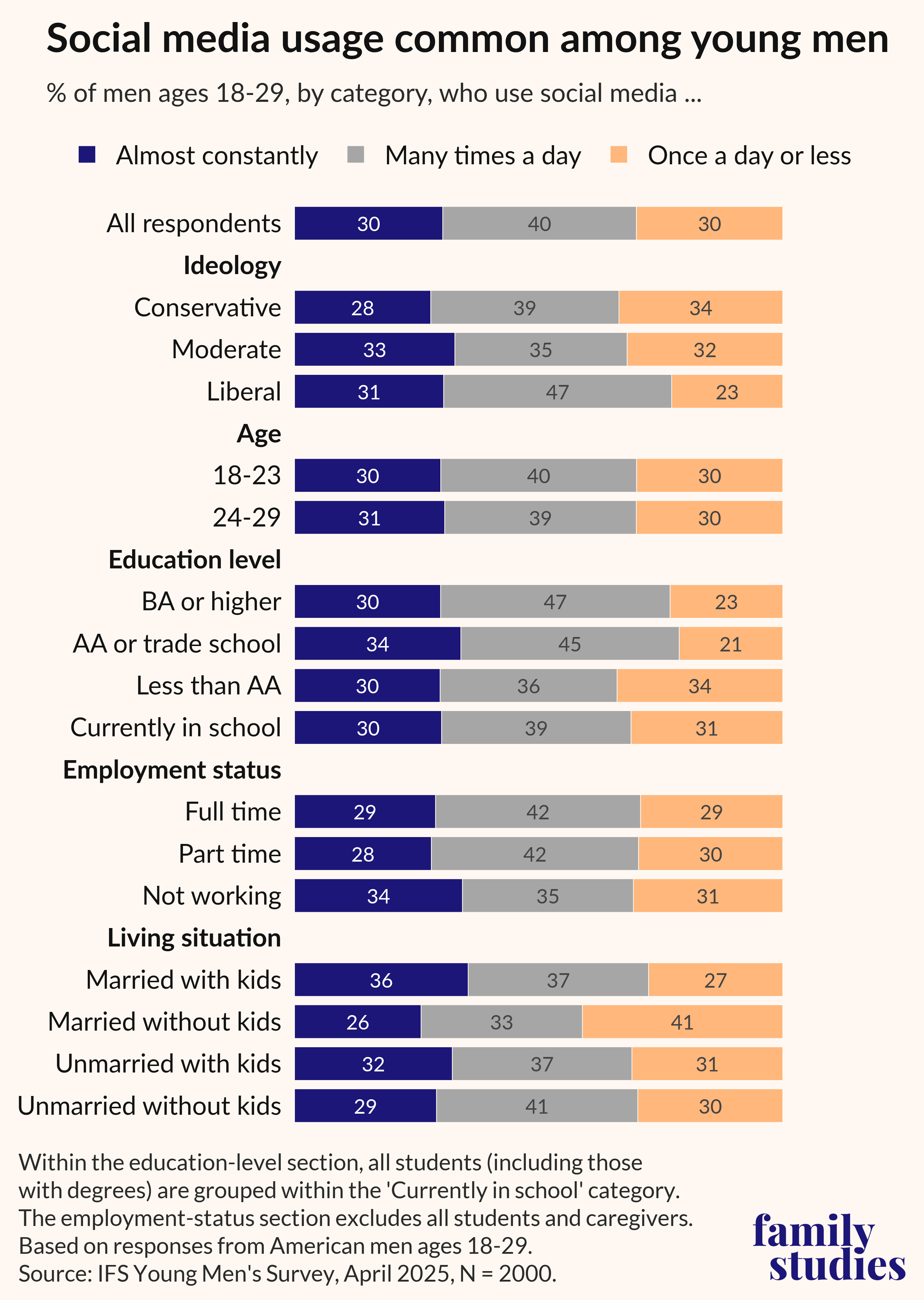
Social media use, the first concern, is nearly universal. Just 4% of young men say they do not use any platform. A majority (70%) are tuned in almost constantly (30%) or many times a day (40%), and in similar proportions across every demographic group, including the full-time employed, conservatives, married parents, and holders of college degrees. Although frequency varies somewhat, there is no social-media-free group of young men.
Gambling
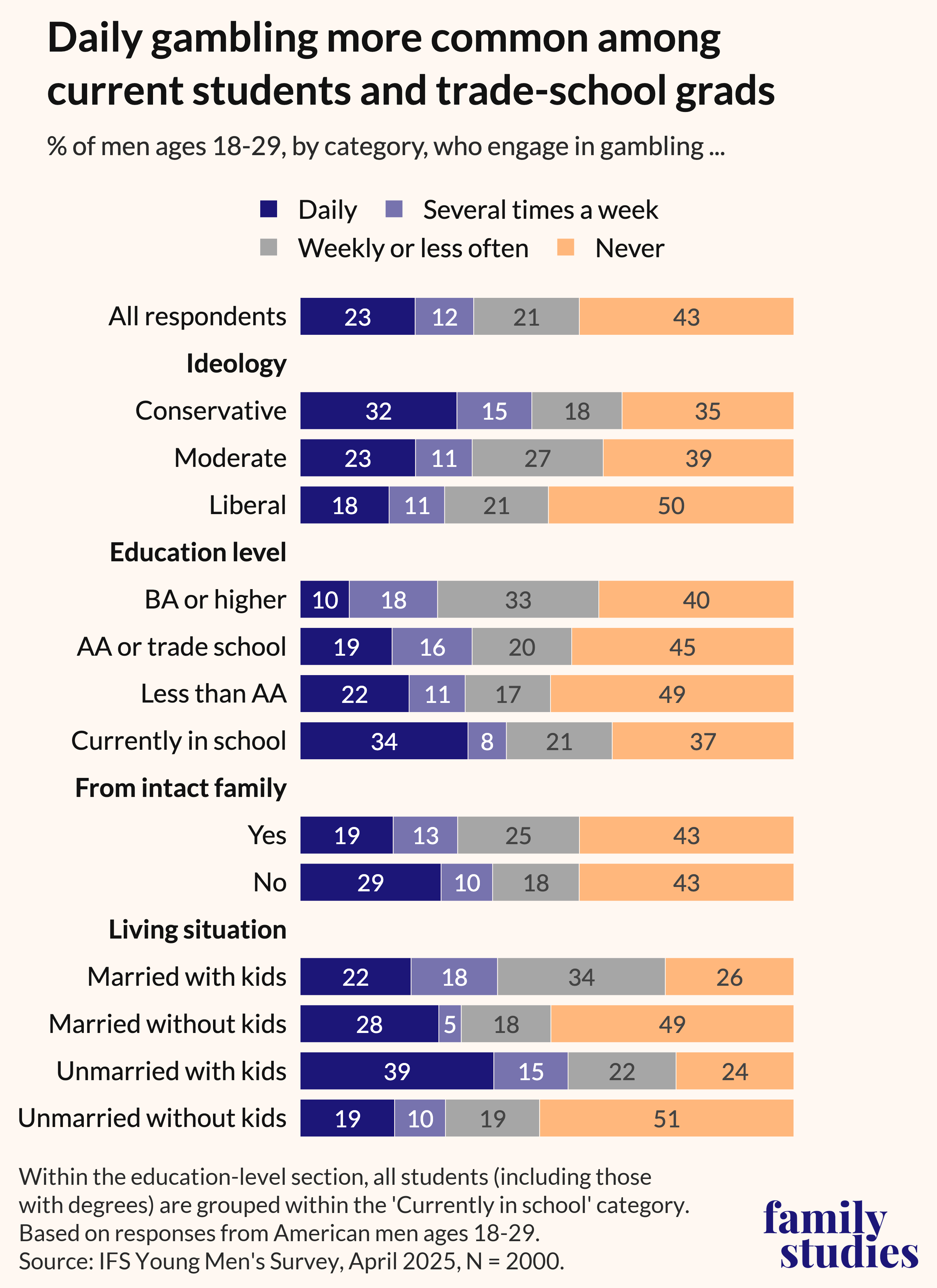
Almost overnight, gambling, including sports and event betting, has become another fixture in the lives of young men. In fact, more than half of young men in our survey are now gamblers. Nearly 1 in 4 (23%) report that they gamble daily, plus 12% doing so more than several times a week, and a further 21% at least some of the time. As the figure below shows, conservatives (32%), those currently in school (34%), and unmarried men with children (39%) are the most frequent daily gamblers.
Pornography Use
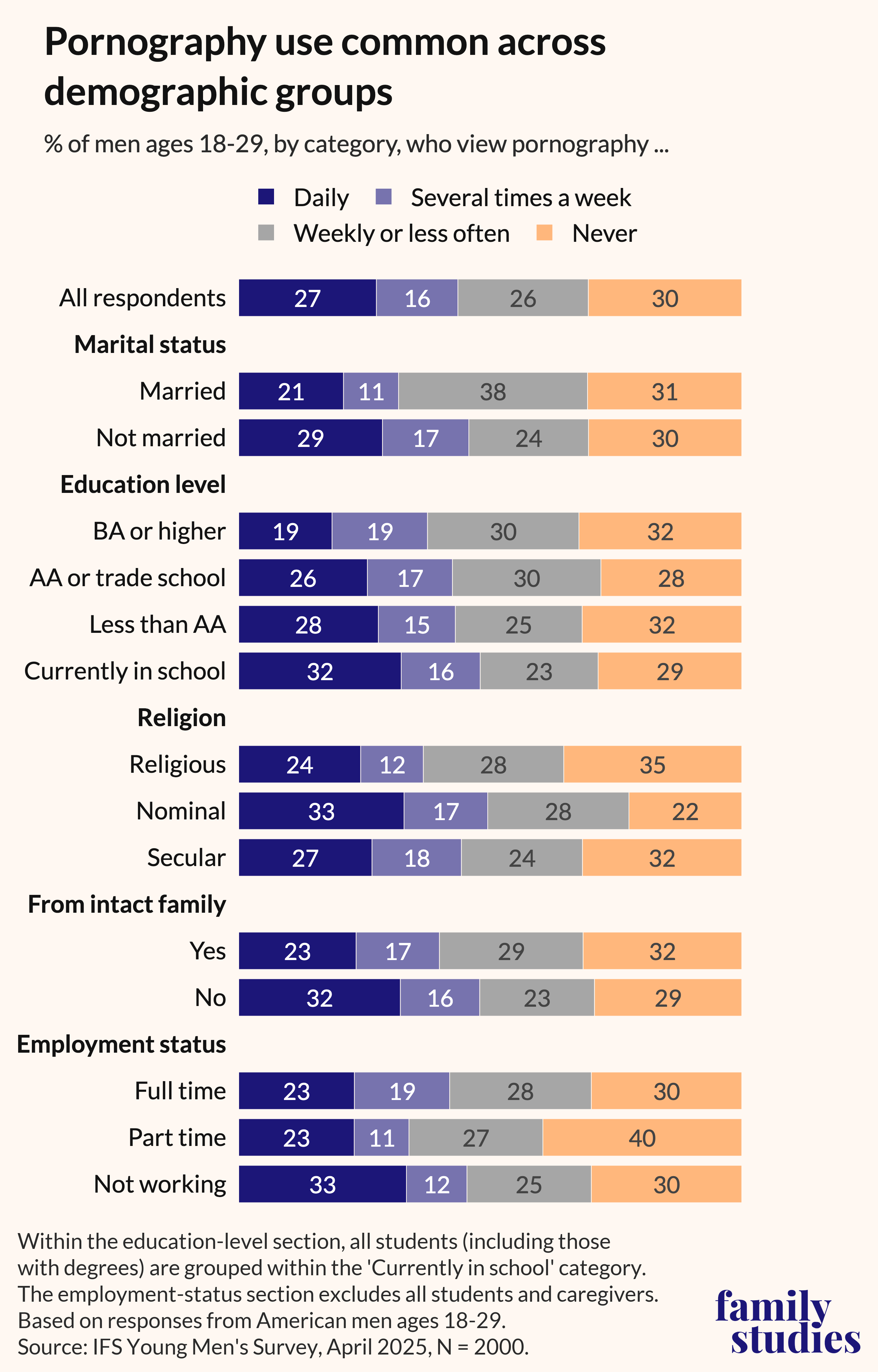
The prevalence of pornography use, the third concern, is well known and well documented. As the figure below shows, 43% of young men say they watch pornography daily (27%) or several times a week (16%), with another 26% about weekly or less. We might expect the daily watchers to be the most troubled, not in work or school, and living in their parents’ basement. While there is some truth to that, we also find daily use among married men (21%), the regular religious service attenders (24%), those who hold full-time jobs (23%), and those currently in school (32%). While 30% of young men say that they never watch pornography, they are not concentrated in any one demographic group.
Video Games
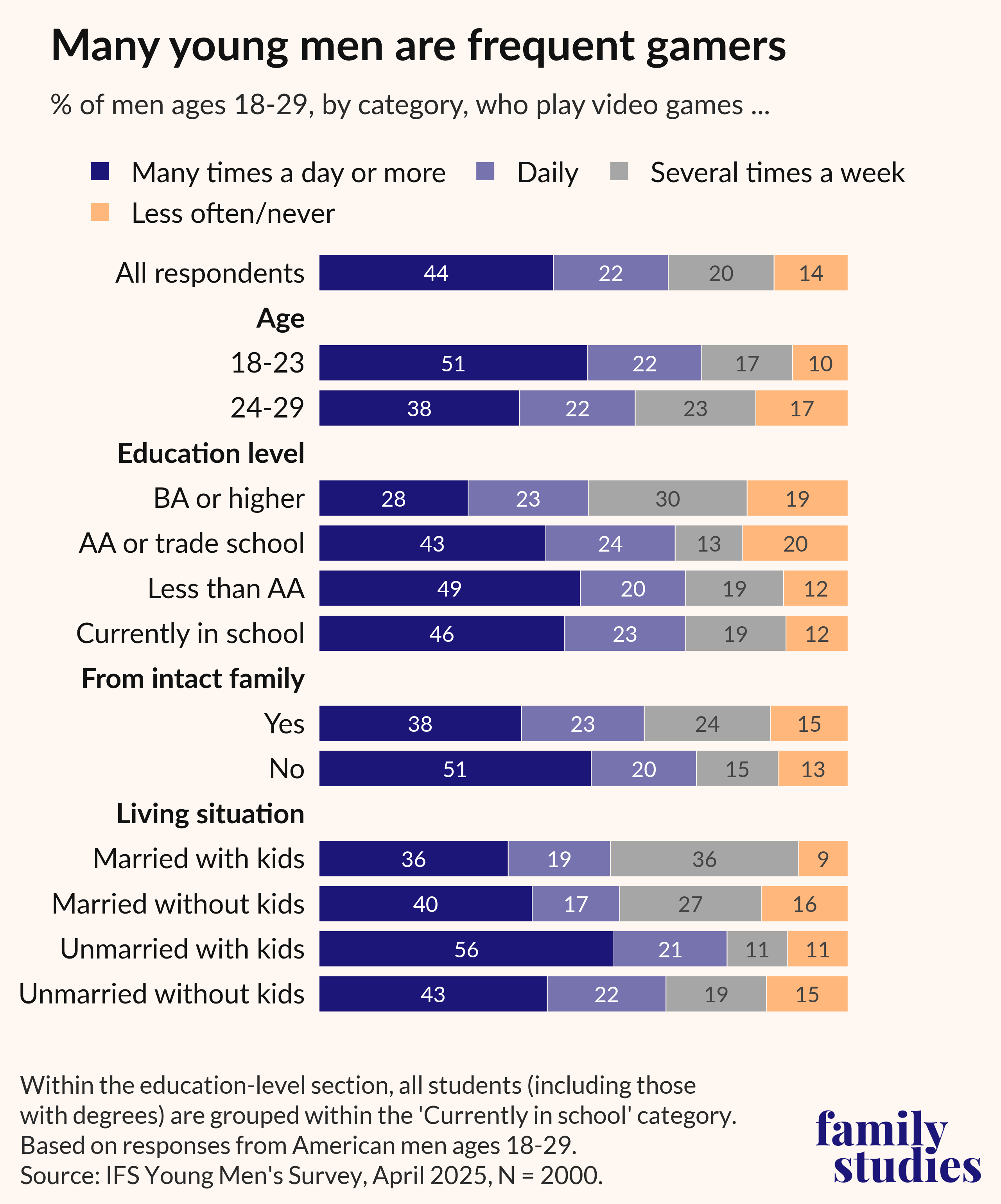
Finally, we turn to gaming habits, which like the other three activities, have become a fundamental feature of the world of most young men. To simplify the next figure, we combined the six use options into four: “many times a day or more,” “daily,” “several times a week or less,” and “never.” Like social media, only a very small minority of young men, 5%, report “never” playing video games. An incredible 44% report playing many times a day or more, and another 22% report playing about “once a day.” Taken together, 66% are playing a video game at least once a day. There is some variation in daily users: younger men and those without a degree play more frequently.
To be clear, the issue here is not with a pleasant pastime, or occasional diversion, or a way to hang out with friends. Some use, of course, does fit that description. For example, we asked young men about the reasons they play video games. About 4 in 10 agree that “an opportunity to interact with others or make friends” is one of their reasons. Their playing is a source of camaraderie and collaboration, which, as we have seen, is often in short supply. A similar percentage agree that playing provides “an opportunity to feel a sense of mastery or accomplishment.” Again, this is the sort of experience that may be otherwise hard to come by. At the same time, nearly half agree that they play as “a way to temporarily escape real-life responsibilities,” and more than 25% as “a chance to be someone different.” These reasons are not all bad, but the escaping doesn’t look so temporary when virtually every free moment is dedicated to playing. The sheer extent of the gaming suggests a compulsion and a lack of freedom, not to mention the many other valuable activities that it obviously displaces.
The confinement is similar with social media, gambling, and the other screen activities that have come to absorb so much of young men’s daily life. Such constant activities are enervating, at odds with other valuable goods in life, including relationships, and yet another cause and effect of demoralization.
Correlations With Distress
Turning now to the question of consequences. Earlier in this chapter, we reported that more than 4 in 10 young men (42%) believe that the statement “all in all, I am inclined to think that I am a failure” describes them “very well” (15%) or “somewhat well” (27%). As the next figure shows, those who engage daily with social media and video games (which is nearly everyone) report feeling like a failure at about the same rate as those who engage less or never. However, those who view pornography (63%) and gamble (66%) every day—along with day trading and playing fantasy sports—are significantly more inclined to see themselves as a failure.
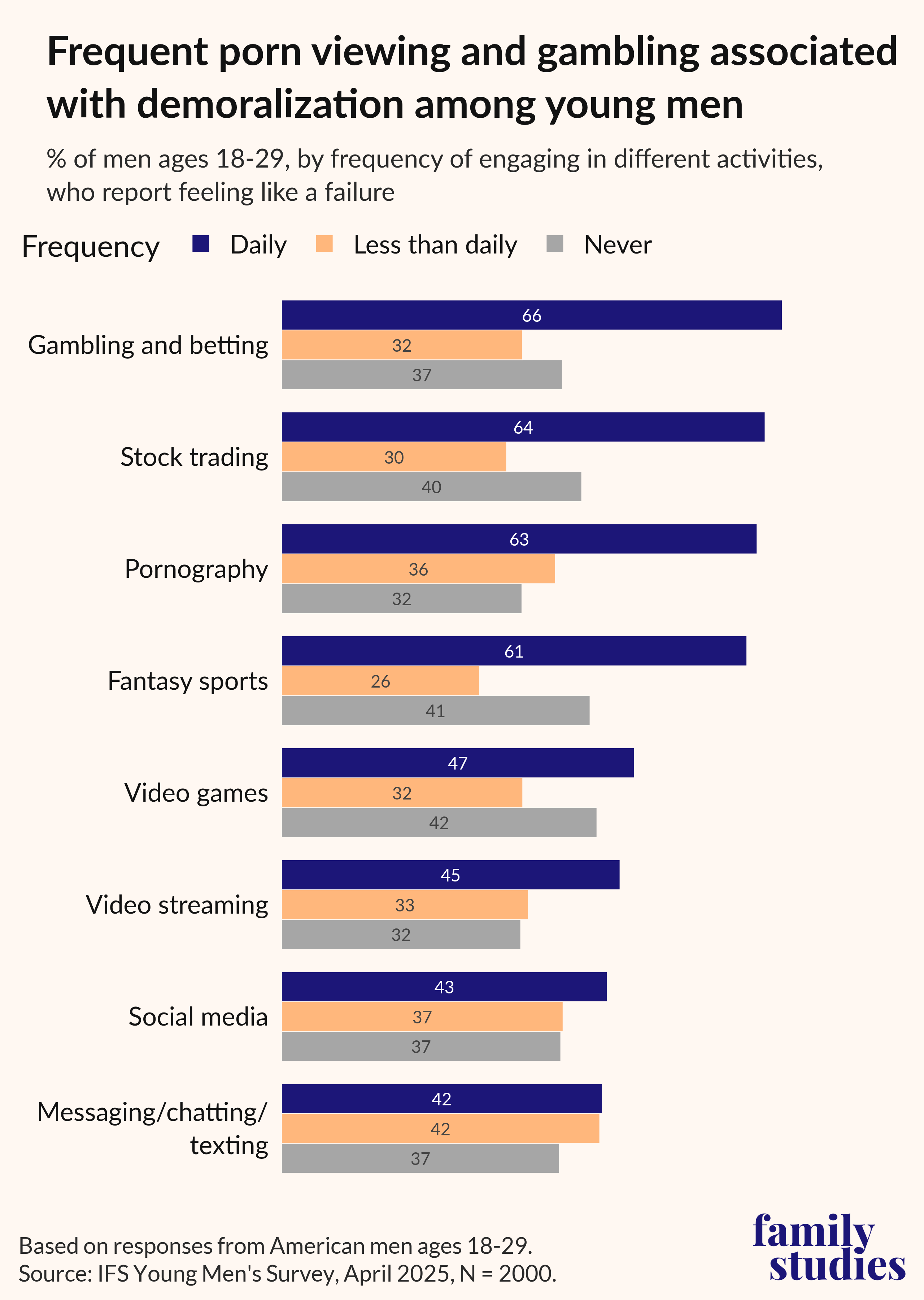
We also found a correlation between high levels of these activities and reported loneliness. Respondents who gamble many times a day or “almost constantly” are more likely (34%) than those who gamble less often or never (24%) to feel lonely all, or most, of the time. With pornography, those who watch extensively (many times a day or almost constantly) are more likely than less frequent viewers to report loneliness (43% vs. 23%), as well as higher rates of anxiety and depression (see below). Those who play video games almost constantly report more loneliness than less frequent gamers (34% vs. 23%), as do constant users of social media (30% vs. 24%).
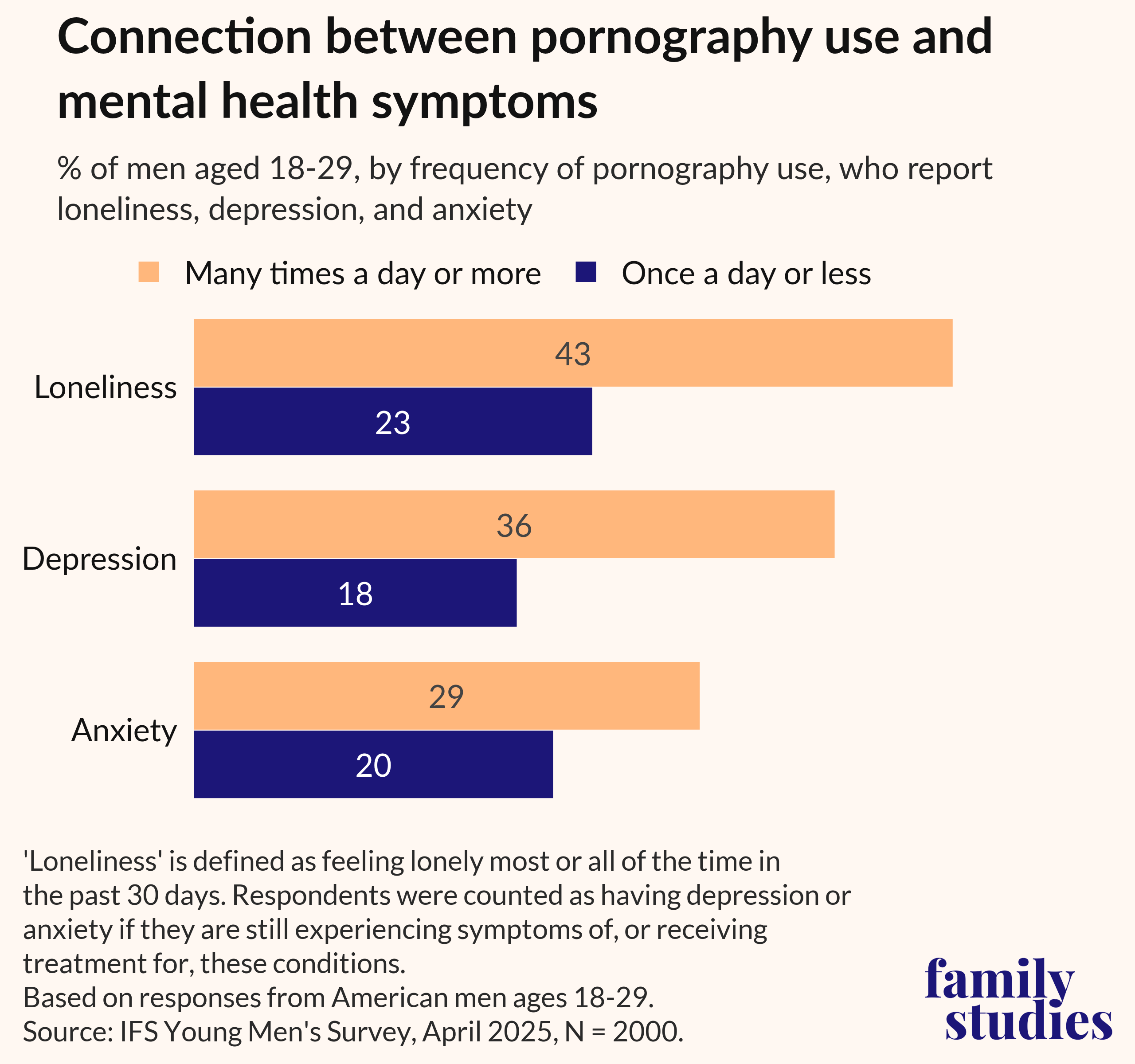
As in other cases, we cannot determine what comes first. Those who watch pornography many times a day or even more, report current depression at twice the rate as those who watch once a day or less. Does watching pornography lead to depression, or do the depressed turn to pornography for relief? The causal arrow may very well go in both directions. But in either case, watching pornography appears to be, at best, ineffective as a coping mechanism for dealing with dejection, stress, and loneliness, and more likely maladaptive.
In the case of gambling, we asked young men for their own assessment of the effects that regular betting (several times a week or more) was having on their emotional health and everyday life. The first question asked to what degree online gambling might be causing emotional distress. As examples of distress, we listed mental pain or anguish, shame, guilt, and embarrassment, and the 5-point response scale was none, mild, moderate, severe, or extreme. The second question, with the same response scale, focused on how much personal trouble their gambling might be causing, such as with relationships or financial, legal, and employment issues.
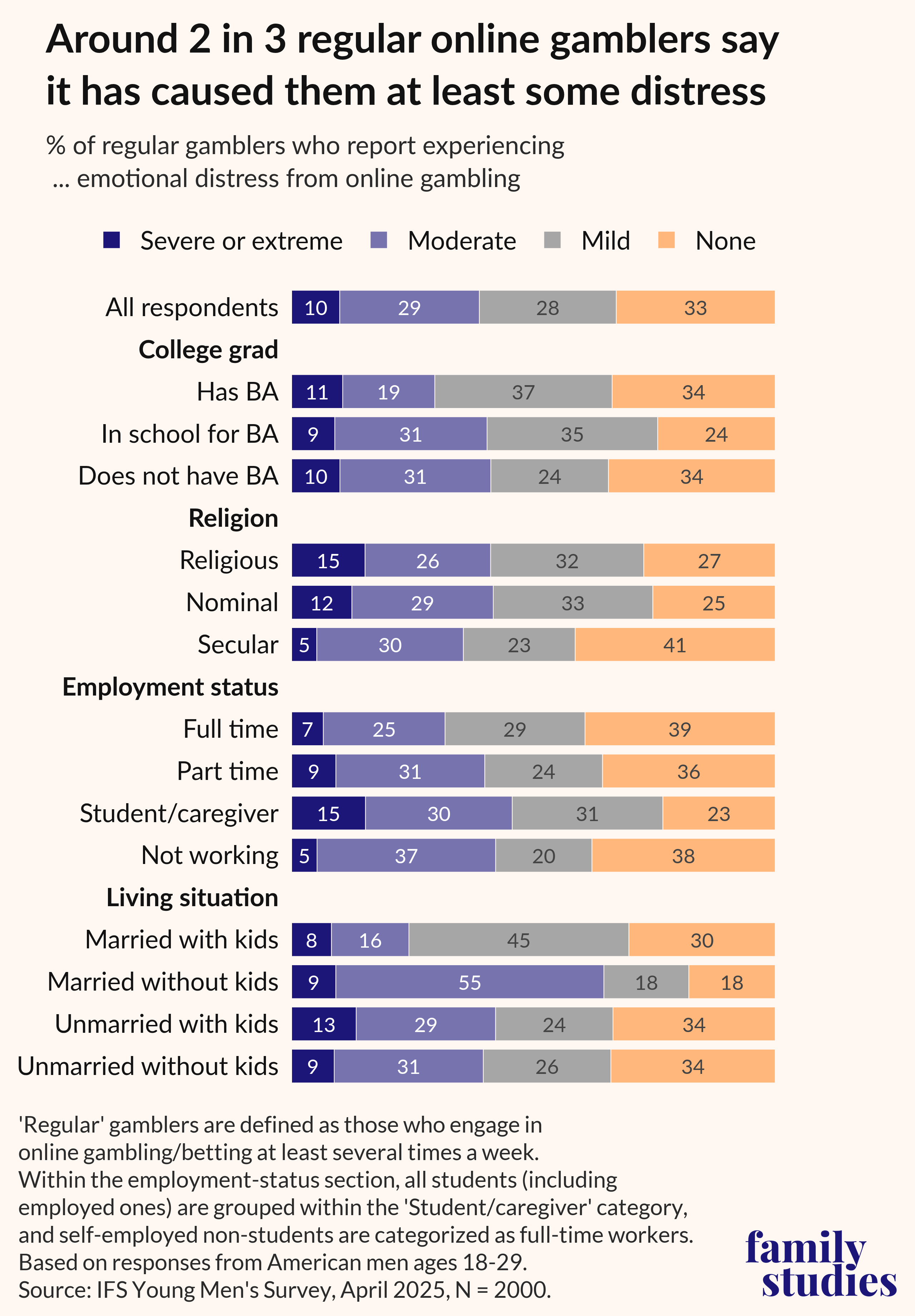
Respondent’s answers strongly suggest that activities like gambling cause distress and create many problems of their own. For both questions, the responses were similar. Around 1 in 10 young men characterize gambling-related distress and life problems as severe or extreme. Another 29% consider them “moderate,” and a similar percentage as “mild.” Perhaps we can see why those who report gambling many times a week or more also report more loneliness. Clearly, gambling, for whatever reason they got involved, is taking a toll that young men themselves recognize and acknowledge.
Editor's Note: This essay is excerpted from Chapter 5 of the IFS report, America's Demoralized Men, Part II.


