Highlights
- A big problem with Costin Alamariu's thesis is that the sex-obsessed lifestyle he espouses is actually anti-natal. Post This
- As we can see from the Christian imperial families, Christianity oversaw a return to the fertility rates that had characterized the rapid demographic growth of the Roman Republic. Post This
Costin Alamariu, who writes under the nom de guerre “Bronze Age Pervert,” is a 45-year-old childless Romanian whose academic career has not managed to generate anything peer-reviewed. To be blunt, his life is similar to what a recent IFS survey showed many young men fear becoming. He is also a poor historian and an even worse demographer; but his provocative aphorisms have won him an online following, and as such, his recent article, “Fertility Cult,” has gone viral. The article seems largely to be trolling religious conservatives, but though it is clearly meant as bait, I am happy to bite: Alamariu’s view of fertility is wrongheaded in numerous ways.
His thesis is not complex: he contends that conventional monogamous sexuality governed by religiously-informed morals, alongside economic modernity, suppresses virile sexual impulses—especially for intelligent men and women. He further argues that modern developments like women’s entrance into the workforce have created additional headwinds against fertility, and thus that successful pronatalism requires a uniquely extreme policy intervention. Specifically, because he believes fertility of high achieving people is especially low, he suggests giving massive bonuses ($500,000!) to people with high IQs who have children, while also launching a state-sponsored fertility cult centered around reverence for male beauty, and particularly the phallus. He also proposes children born in this program could be raised in state-run orphanages, so parents don’t face many burdens. But his emphasis on creating a modern-day sex cult is derived from his belief that ancient societies sustained high fertility via reverencing male virility, and that religious norms suppressing this reverence are a root cause of low fertility.
It is a disappointing testament to the modern information economy that there is a need to respond to these kinds of ravings, but that’s the internet for you. Unfortunately, to rebut Alamariu’s call for Dionysian orgies to boost fertility, this post will be forced to include some descriptive content that is not entirely PG-rated.
In this post, I’ll rebut three of Alamariu’s core arguments. First, I will show that his claims about ancient demography, which he uses to justify what he calls “Dionysian orgies,” are simply false. Second, I will show that his claims about modern fertility vs. intellectual and professional abilities are also false. Third, his argument that religious sexual norms may be reducing fertility is completely incorrect—indeed, “Dionysian” sex lives are particularly infertile.
Pagans Were Bad at Making Babies
Alamariu’s historical argument in favor of phallus-cults rests heavily on three historic cases: 1) Spartan laws pressuring Spartan elites to reproduce, 2) Christianity failing to boost low fertility among Roman elites, and 3) an argument that ancient Greek fertility was high due to Dionysian-like phallus-reverencing. He errs in all three cases.
Sparta did indeed have laws to try to promote fertility. Sparta went to great lengths to do as Alamariu suggests—glorify the virile male, celebrate male youth, and set aside conventional morality to ensure elite reproduction. Yet Alamariu doesn’t mention a fact every student of Spartan history knows: these laws totally failed. Sparta’s radically elitist culture went to extreme lengths to try to propagate the elite lineages, yet failed, such that the population of Spartiates peaked at perhaps 8 to 10,000 around the 700-500 BC. By Aristotle’s time in the mid-300s, under 1,000 remained, and Sparta was replenishing its ranks by promoting lower-class Spartans to the elite ranks en masse. By 200 BC, the few remaining Spartans were exiled by a populist leader named Nabis, who abolished their privileges, freed their slaves, and then gave their wives away to his political allies. Giving Spartan elites every advantage, favor, and sexual glorification not only failed to lead to elite reproduction, but it also eventually led to elite extinction and peasant rebellion.
Christianity certainly did boost fertility among Roman elites—dramatically.
Alamariu also argues that fertility was low for Roman elites in the early empire, and that when fertility did rise in the eastern empire under Christian influence, it was under fundamentally different elites, i.e. not a continuation of the genuine Roman elite. This is a forgivable error: Alamariu cannot be faulted for repeating a common view among many scholars. But it turns out, Roman fertility was highest for elite men—and lowest for commoners.1 What the data show, based on original analysis I conducted, is that Roman elites had comparatively high fertility rates—they reproduced just fine. It was commoners and slaves who had the lowest birth rates.
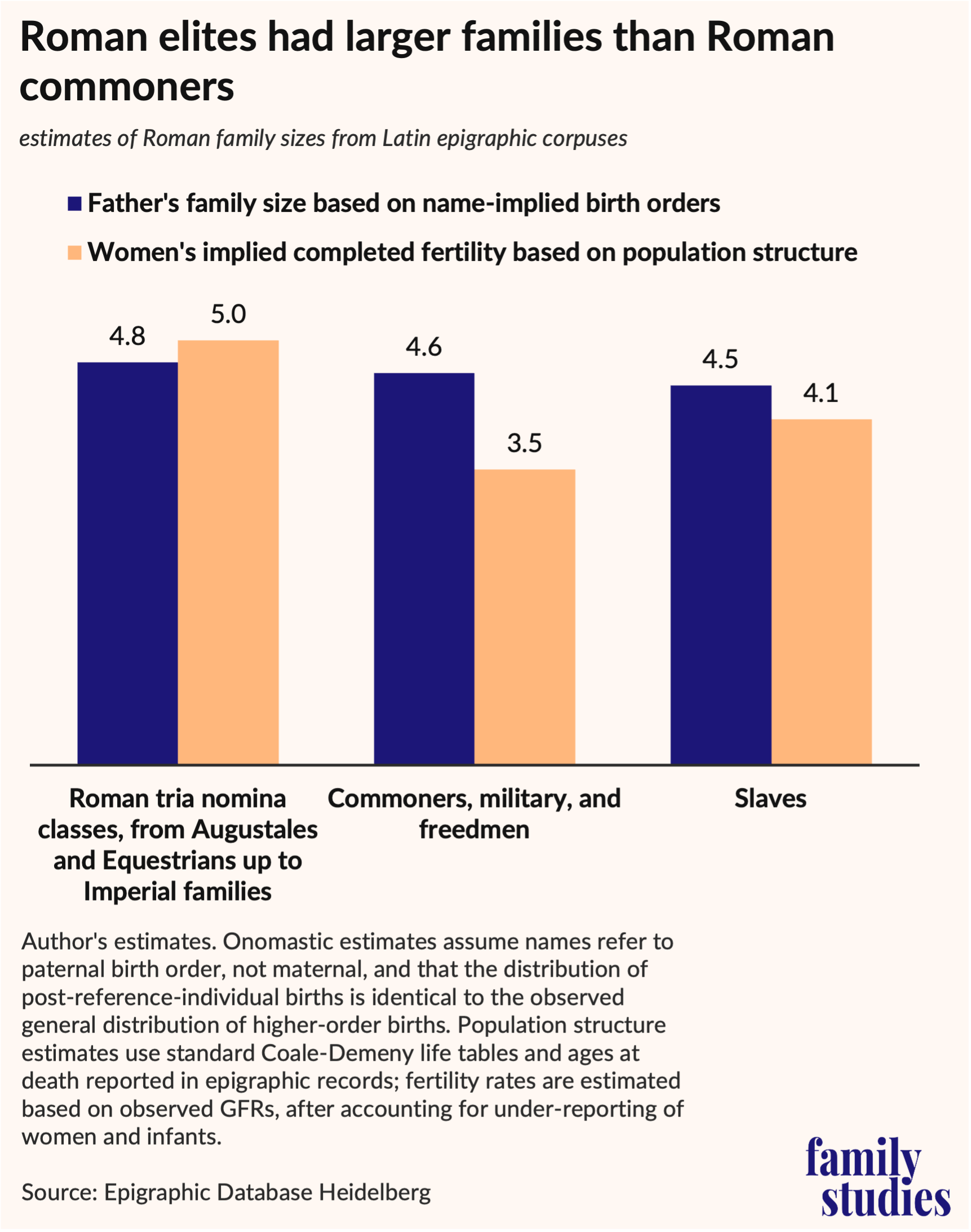
Failure of elite reproduction was not the cause of Rome’s fall. Rome fell because the average, everyday people—those who did the farming, trading, and most of the fighting—simply became thinner on the ground as plague reduced their numbers and urban diseases and zero-sum status competition reduced their natural growth rate. When the final wave of barbarians toppled Rome, those barbarians weren’t even numerous—genetic evidence shows the Visigoths who conquered Spain, for example, were a very small group essentially only replacing elites.
More to the point, Christianity certainly did boost fertility among Roman elites—dramatically. The best case-in-point for this comes from consular and imperial families themselves, the most elite of the elite. The figure below uses a method pioneered by historian Walter Scheidel to infer prevailing fertility rates in the social circles around elite families.
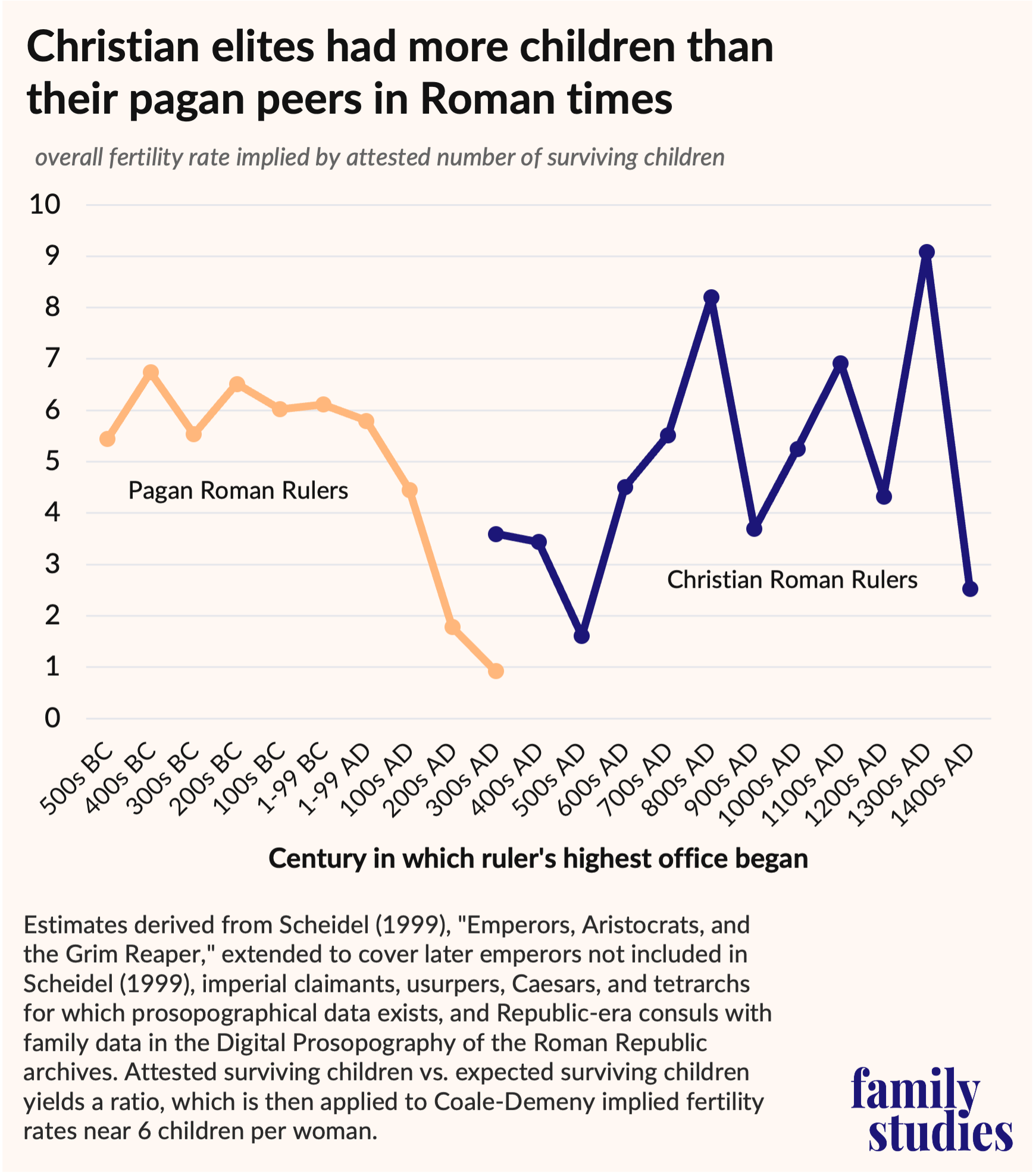
At the highest rung of the pagan elite during the Republican period, Roman consuls seem to have had fertility rates around 6 children per man for nearly the whole span of the Roman Republic. But when Augustus established the Principate and consolidated power in himself, fertility rates for the most elite families crashed, from 6 to 2 children or less. Yet, while the last two centuries of pagan emperors averaged 2 children or less, the first two centuries of Christian emperors averaged over 3 children each. By the 600s and 700s AD, Christian emperors of the eastern Roman empire were averaging around 6 children each, though estimates are more volatile since the sample size for Christian emperors is much smaller than the sample size for Republican-era consuls.
Thus, where we can observe religion among the most extremely elite families in the empire, Christians avoided the lowest-low fertility rates of the pagan imperial families and were able to restore fertility rates equivalent to those observed among Roman Republican consular families. Among the higher social classes generally, however, fertility simply never dropped as low as it did for the imperial families. Rome’s rise to power and its subsequent decline were mainly shaped by common fertility rates (except insofar as failure to establish long-term dynasties fueled civil war), and, regardless, Christianity clearly led to higher fertility rates for the most elite families.
While Alamariu suggests this was some accidental feature of an otherwise ascetic and celibacy-friendly faith, this reading is nonsensical: Christians were notable for their distinctive sex lives from the earliest days of the faith, as Rodney Stark has argued. While Christianity was historically divided by debates about family life (“Jovinian” dissidents wished to elevate it to a pinnacle of honor, while “Encratite” sects deprecated it), the Christian mainstream broadly rejected both family-cultism and ascetic extremism as the normative path. Instead, as we can see from the Christian imperial families, Christianity oversaw a return to the fertility rates that had characterized the rapid demographic growth of the Roman Republic, a period scholars see as highly familistic.
By the time of Emperor Heraclius (who had 11 children), the imperial family’s affectionate, romantic, and fecund family life was widely and publicly upheld as an ideal for Christian families. The notion that Christianity was an anti-sex cult is nonsense. It was, of course, an anti-pederasty movement: whereas the age at first marriage for Roman pagan girls could be as young as 12 or 13 (though the median age was 16 or older), Christian girls tended to marry a few years later than pagans. Alamariu’s fixation on celebrating the beauty of young male bodies was a fixation Christianity worked hard to suppress.
Finally, Alamariu argues that Greek fertility was high due to phallus-worshipping fertility cults. There is no evidence at all for this claim; in fact, neither ancient authors nor modern scholars have ever argued that Greek fertility was unusually high. Greek populations did expand rapidly in the Classical period, but this was not primarily due to high fertility. Rising living standards meant that mortality rates declined, and indeed skeletal data from excavated cemeteries in Greek cities supports the idea that Greek population growth was achieved by finding ways to moderately reduce child mortality. Fertility cults had nothing to do with it.
Fertility Is Not Low for High-Achieving People
Alamariu’s broader argument rests on a simple thesis: to function, society needs elites (especially the very intelligent) to reproduce at high rates. The fact that the educated, rich, and smart are not having many babies is, therefore, of great concern.
The problem with this thesis is that the educated, the rich, and the smart have actually not seen a sharp decline in fertility. In the 2020-2024 Current Population Survey fertility supplements, women over age 44 with a graduate degree in households making over $150,000 in income averaged 1.83 children. Women with a bachelor’s degree and over $150,000 in household income average 2.06. Women with just a high school diploma averaged 2.01 households over $150,000—but those less-educated women also had about 2 children in households making under $50,000. There was little gradient in fertility across education or income!
Using the National Longitudinal Survey of Youth—1997 and 1979 cohorts, we can explicitly test how cognitive ability relates to fertility and how that has changed over time. That’s because the NLSY-datasets include ACT, SAT, PIAT, and AFQT scores, as well as fertility for the respondents in their early 40s. If academic high-achievers postpone fertility longer, then relative fertility rates for high-scoring individuals could be underestimated, but broad trends should still be clear.

Clearly, fertility differences across measured cognitive abilities are not that large. Men with 2 or more standard deviations of test scores below the NLSY mean have a bit less than 2.1 children per man; at 2 or more standard deviations above, they average about 1.9 kids. That’s a very small difference when we’re talking about the difference between young people with perhaps a 60 point gap in approximate IQ! For women, the same estimates are about 2.3 and 2.1 children—similarly small. Comparing the cohort born in the 1960s to the 1980s, fertility rates have risen for the highest-scoring men and women.2
The entire concern about smart people going extinct is unfounded. In the past, I’ve even shown that the genetic predictors of intelligence don’t even predict lower fertility. This line of reasoning is based on a simple factual error.
Religion Makes More Babies
Finally, Alamariu’s argument suggests that the domesticated sexuality of Christian marriage is, at root, part of the problem of low fertility and that more elite promiscuity is a good solution. One of the many problems with this theory is that the sex-obsessed lifestyle he espouses is actually anti-natal.
In the U.S., based on data from the National Survey of Family Growth, completed fertility is around 2.2 children per man for married-or-cohabiting men who have only ever had sex with one woman. It is around 1.7 for men who have 5 or more lifetime partners (and indeed around 1.7 for men who have had 50 or more lifetime partners). Playboys are going extinct because their life strategy is inferior, from a purely reproductive standpoint.
Monogamy wins partly because humans are genetically predisposed for monogamy, but more specifically, it wins because virtually all prospective parents know two things: 1) kids are a long-term investment so you want a strong guarantee of long-term support; and 2) spending time with your kids is not only a cost of having kids, it's also a benefit!
The reality is that love for spouse and the children you make together are what actually motivate fertility, not phallus-worshipping recklessness.
Alamariu recognizes his orgiastic fantasies would ruin the usual means of raising children in a stable pair-bonded relationship. His solution is state-sponsored orphanages (he describes them as luxurious “nurseries"). It is worth repeating here that Alamariu was born in Romania during the period when Romania’s government was promoting the abandonment of children in orphanages as part of a scheme to create loyal Communist subjects. To my knowledge, Alamariu has not publicly discussed his own family’s experience of this policy environment during his childhood, but the proposal he makes for pronatalism is very similar to the Bolshevik abolition of marriage in the 1920s, and shares remarkable resemblance to the circumstances of his own country of origin. A policy branded as “vitalism” turns out to just be Marxism.
But besides the unusual intellectual pedigree, Alamariu’s reckless orgies underwritten by state-sponsored orphanages wouldn’t even work. As stated earlier, the desire to be with kids is a key reason most people have them. Most people do not want to simply have their genes out in the world, somewhere, unconnected to their own life experiences. Sperm or egg donation can achieve that goal, yet people still insist on having “their own” children.
This is why pronatalists often fixate on social values and cost factors around parenting, childrearing, child care, and more: parenting is overall a positive experience, but changes in prevailing social norms, values, normative expectations of parents, and costs for various goods and services have made parenting much harder and less pleasant than it need be. In fact, this is also why religion is so important for understanding fertility, a connection Alamariu mocks: some specific religious beliefs alter how people see their children and their role as parents. This shows up clearly in data on religion and family life.

Religious people enjoy kids more and are likelier to see children as a gift, with no difference in the odds they see children as an obligation. Meanwhile, the most secular and most religious parents also have different degrees of anxiety about parenting. The kind of neurotic, high-anxiety parenting Alamariu condemns is exactly what modern American religion suppresses in its members.

As can be seen, the most secular American parents have the highest agreement with a statement about the stress of parenting, assign the highest difficulty rating to parenting, and give the strongest endorsement to the idea of postponing family until stability, while the most devout Americans are less worried about achieving stability before kids.
Put bluntly, Alamariu’s view that caution, conscientiousness, and anxiety among America’s elites may be retarding birth rates has a simple antidote: elites could simply convert to Christianity and absorb the lower-stress parenting norms people of faith promote. This may seem like a silly proposal, but Alamariu’s solution—that elites convert to a phallus-worshipping fertility cult—is obviously a lot more ridiculous.
Consistent with the idea that enjoyment of being with kids is a key part of fertility motivation, and thus that state orphanages would be antinatal, the figure below shows that much of the overall difference in family desires between the religious and nonreligious is explained by views of children as a source of joy.
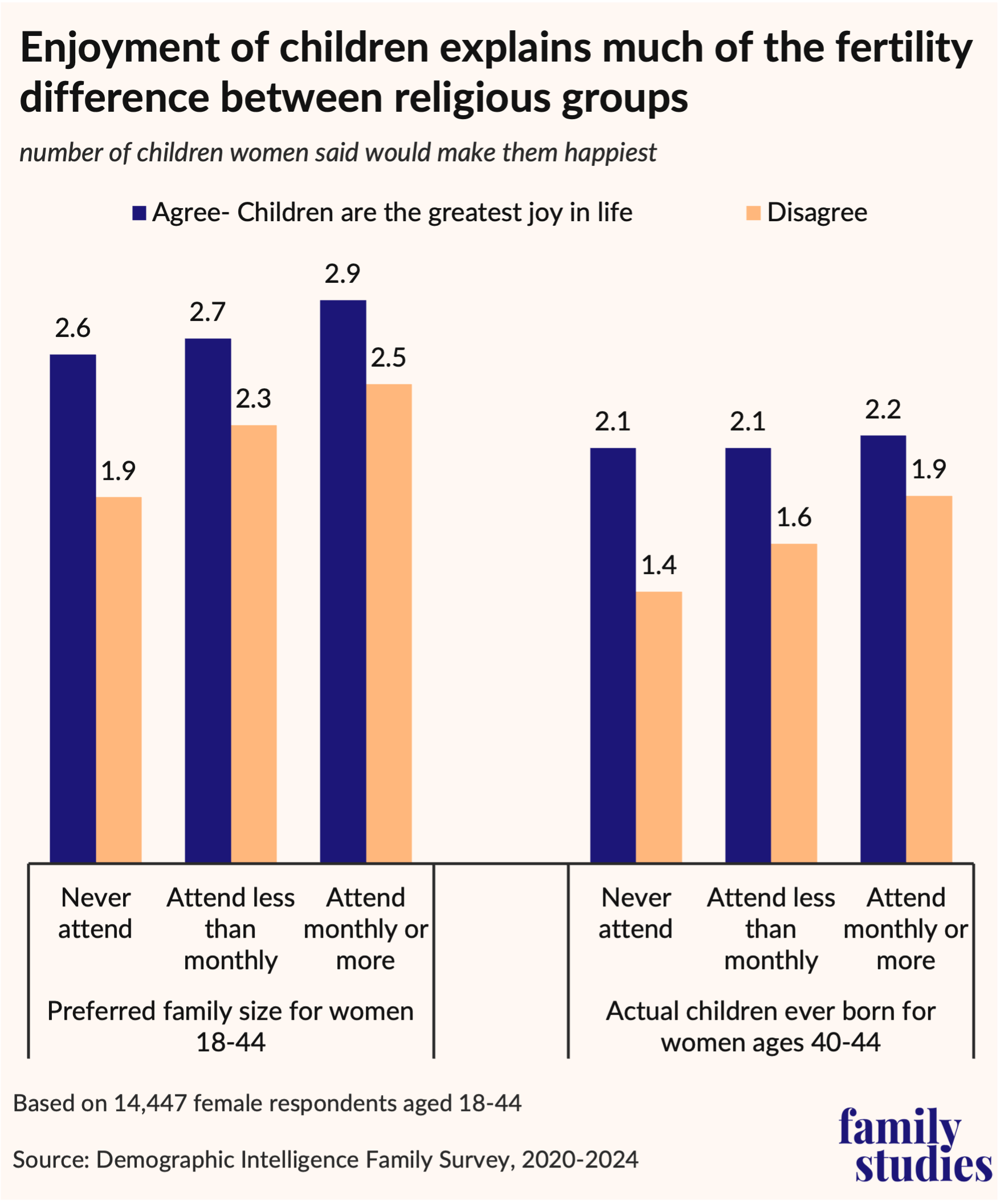
Among respondents who say that children are the greatest joy in life, religiosity predicts little difference in desired family size, and essentially no difference at all in actual kids born. Among respondents who do not see kids as the greatest joy in life, some differences remain—religious people who don’t enjoy kids also have other reasons to have them.
What Really Motivates Fertility
Whereas Alamariu mocks the religious argument for children in his essay, the reality is that love for spouse and the children you make together are what actually motivate fertility, not phallus-worshipping recklessness. Whereas Alamariu thinks people should have kids for cash, drop them in an orphanage, and not think twice about it, in the real world, the ideas that truly motivate family behaviors are things like imagining yourself teaching your son to shoot your grandfather’s shotgun, or taking your daughter out to tea on a spring afternoon, or teaching your teenager to drive, or sharing a cherished family tradition.
In fact, religion is highly pronatal because many forms of religious life (though not all) tend to: 1) provide parents with opportunities to see their children enjoy cherished traditions; 2) stabilize marital bonds that add joy to family life; and 3) give people reasons to have kids. Moreover, because religion is one of the main buffering mechanisms societies have used since the dawn of time to quell negative psychological effects, it remains true today that religious people are less worried about having kids and so they have more of them. To allay paralyzing anxieties, America’s elite don’t need orgies, but they might need baptisms.
Lyman Stone is a Senior Fellow and Director of the Pronatalism Initiative at the Institute for Family Studies.
*Photo credit: Shutterstock
1. This can be demonstrated two different ways: first, by leveraging birth-order data contained in Latin names left behind in Latin inscriptions, which allow us to infer typical patrilineal family size across different social classes of Romans; second, by leveraging age-at-death of Romans in the same database to infer population structure for ancient Latin-speaking Roman populations and, therefore, implied fertility rates. The data used for this exercise comes from the Epigraphic Database Heidelberg (EDH).
2. And even such differences across ability levels as we do observe shrink dramatically if the sample is restricted to exclude Hispanic respondents, whose lower English proficiency often leads to test scores incorrectly measuring cognitive ability. Indeed, in the 1980s cohort, only Hispanic respondents have a strong within-race negative correlation between test scores and fertility, which is likely an artefact of immigrant origins and language difficulties on tests.