

Highlights
- Parents who feel more supported report better experiences of parenting across the board. Post This
- The people who feel the most supported by their communities are those leaning on them least. Post This
- Religious Americans often get four instances a week of help with their kids, while the entirely nonreligious may get just two. Post This
Child care is a huge line item in many families’ budgets, child care costs are routinely cited as a barrier to family formation, and parenting bloggers often talk about the need for community, or a village, to help raise children. These various examples all point in one direction: help watching kids, or what scholars call “alloparenting,” is very important for family life. If we as a society can marshal more support for parents, then parenting might become easier and more rewarding, and—perhaps—couples will have more kids.
But there’s a huge, if usually unstated, gap in this theory: Does getting more free help actually make families feel better about parenting? Do people who receive a lot of support really feel supported? If communities could simply band together to support parents more, would parents feel more supported (and less stressed)?
Based on our survey of 24,000 U.S. parents, the answer seems to be “no.”
While parents who feel more supported by their communities do report a range of more positive experiences, parents who actually get more concrete help from their communities don’t feel more supported. The main factors shaping which parents feel more supported are income and socioeconomic class. What makes parents feel most supported by their communities are things like earning a decent wage and living in a nice, safe neighborhood.
Parents Who Feel Supported Do Report More Positive Experiences
We measured subjective support through an index of questions about parents’ feelings of support. Specifically, we asked respondents if they felt society at large mostly supported or undermined their parenting, then asked the same question about their immediate community. About two-thirds of parents answered that they felt supported to the first question, and about three-fourths said they felt supported on the second question.
We also asked parents if most parents in their community parented “in a similar way” or “quite differently” compared to how they parent, and we also asked if other parents in their community had similar views concerning what degree of supervision kids need. About 60% said others parented very similarly to them, and about three-fourths said other parents shared their views of supervision.
Finally, we asked parents to rate how often they felt judged or criticized for their parenting, ranging from “Almost never” to “Almost always.” From these questions, we created a “support index,” where 0 indicates a respondent who gave the “less supported” answer to every question, while 1 indicates a respondent who gave the “most support” answer to every question.
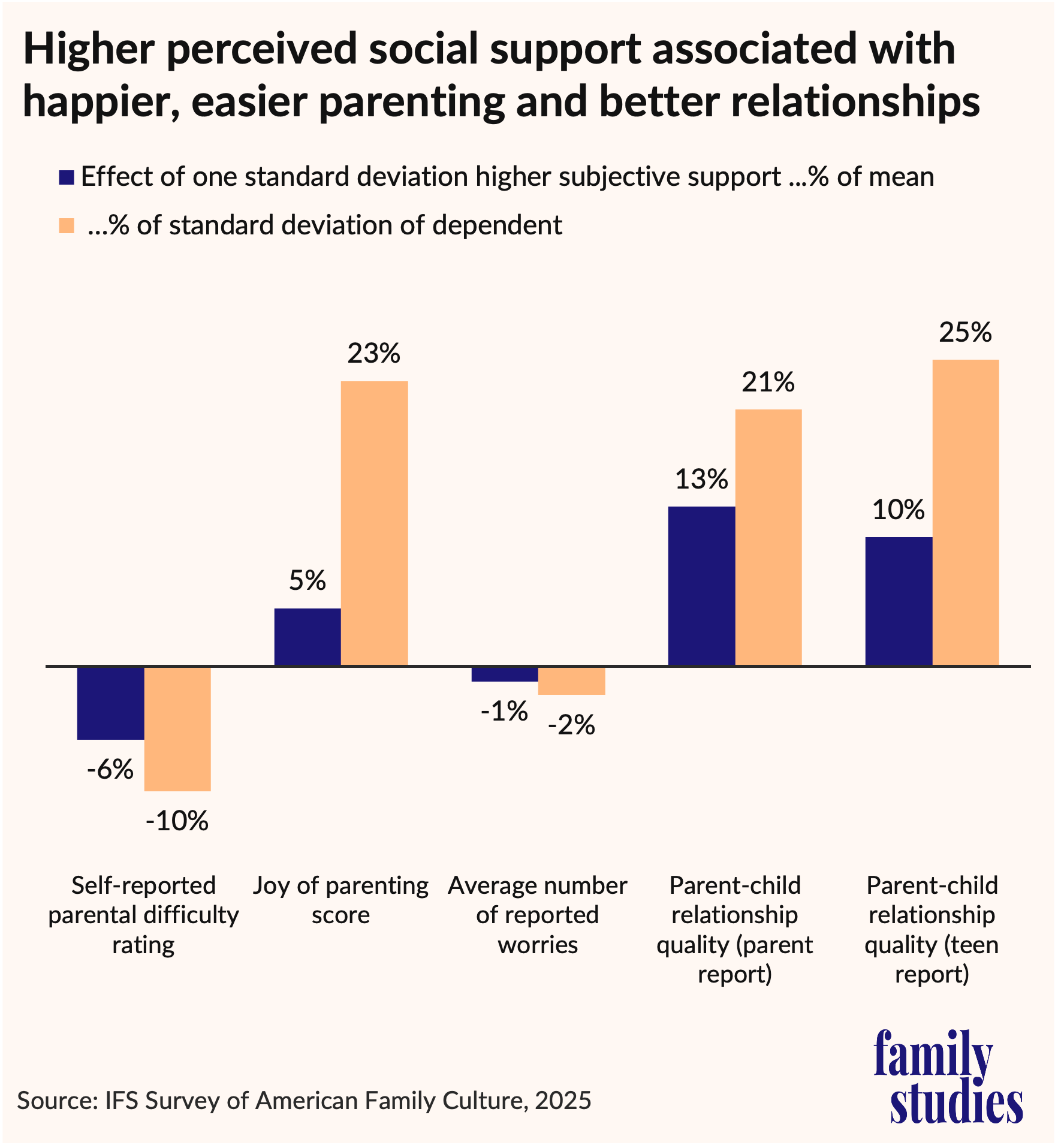
This support index has a strong correlation with a lot of different variables. Parents who feel more supported report better experiences of parenting across the board, as the figure above shows.
Besides these parenting indicators, parents who feel more supported are also just happier in general, as this figure shows.
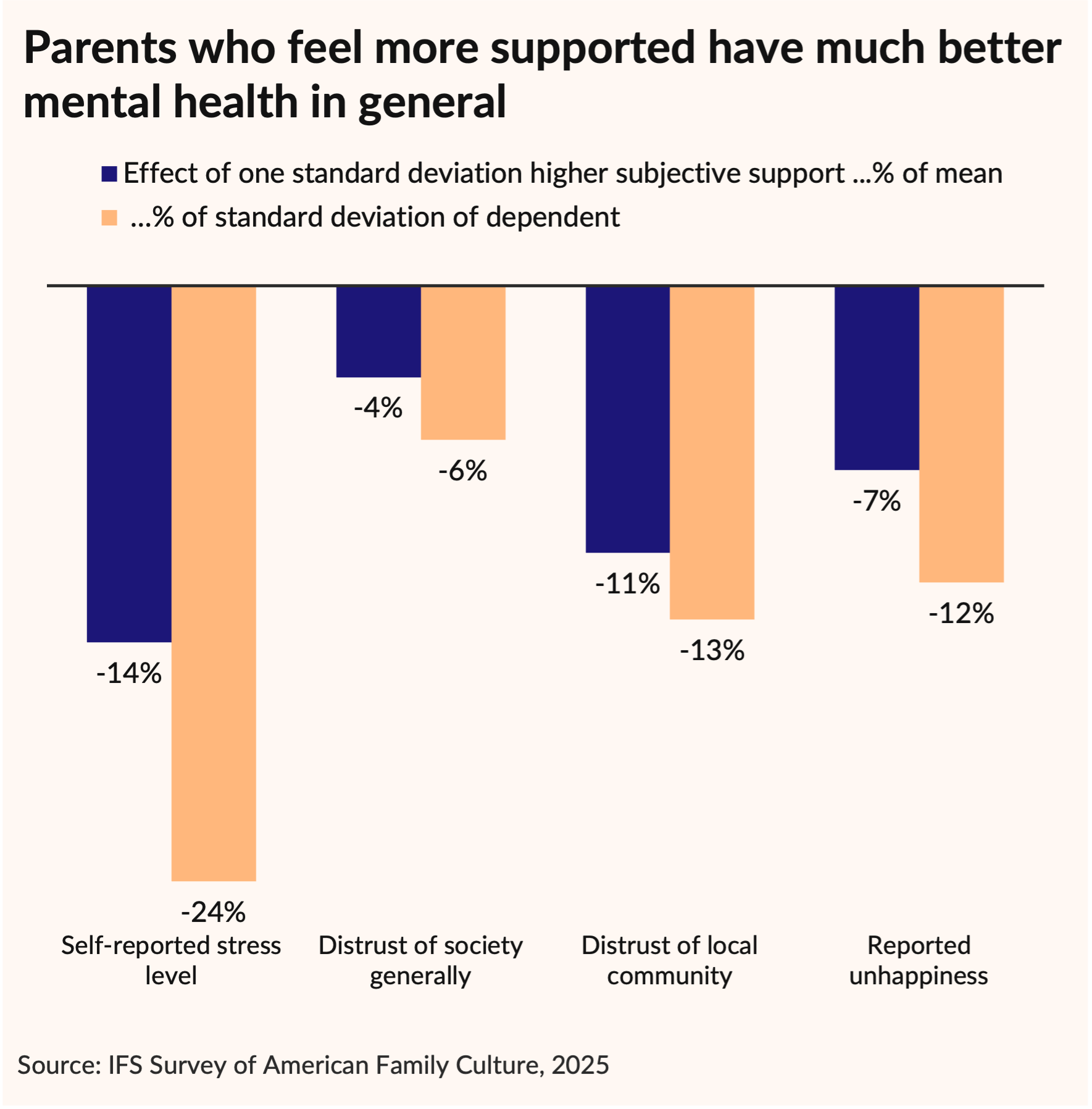
Of course, a particular kind of spurious correlation is very likely: parents who are generally stressed, untrusting, or unhappy may also experience more subjective difficulty or unpleasantness in parenting regardless of how much support they receive. But this turns out not to explain these effects: perceived community support has about the same effect on subjective rating of parental difficulty, or parent-child relationship quality, for parents who are very happy or not too happy, or parents who trust their neighbors compared to those who don’t. Our interaction tests found that, though feeling supported was related to parental mental health, the effect of feeling supported was not eliminated by fully controlling for parental mental health.
The simplest explanation is probably the right one: to the extent parents feel they are experiencing “the village,” and to the extent parenting connects them to other people and other parents, and to the extent they feel their parenting is admired, their experience of parenting can be very positive, even if the rest of their life is stressful.
Parents Who Actually Get More Help Have Mixed Experiences
In our survey, we measured objective support through child care. Specifically, for every kid under the age of 14, we asked parents how many days each week the child was watched for any amount of time by unpaid family members, and, separately, by unpaid friends, colleagues, church members, etc. Free help for a child peaks at age 1: in our sample, the average 1-year old was watched for some amount of time on about 3.5-4 days a week by some family member (other than members of the household itself) or friend.1 Alloparental support declined with child age, falling to around 2 to 3 days a week by age 13.2
To begin, we can look at who gets more help with their kids.
Three variables in particular stand out: religion, proximity to parents and in-laws, and trust in local community. Religious Americans often get four instances a week of help with their kids, while the entirely nonreligious may get just two.
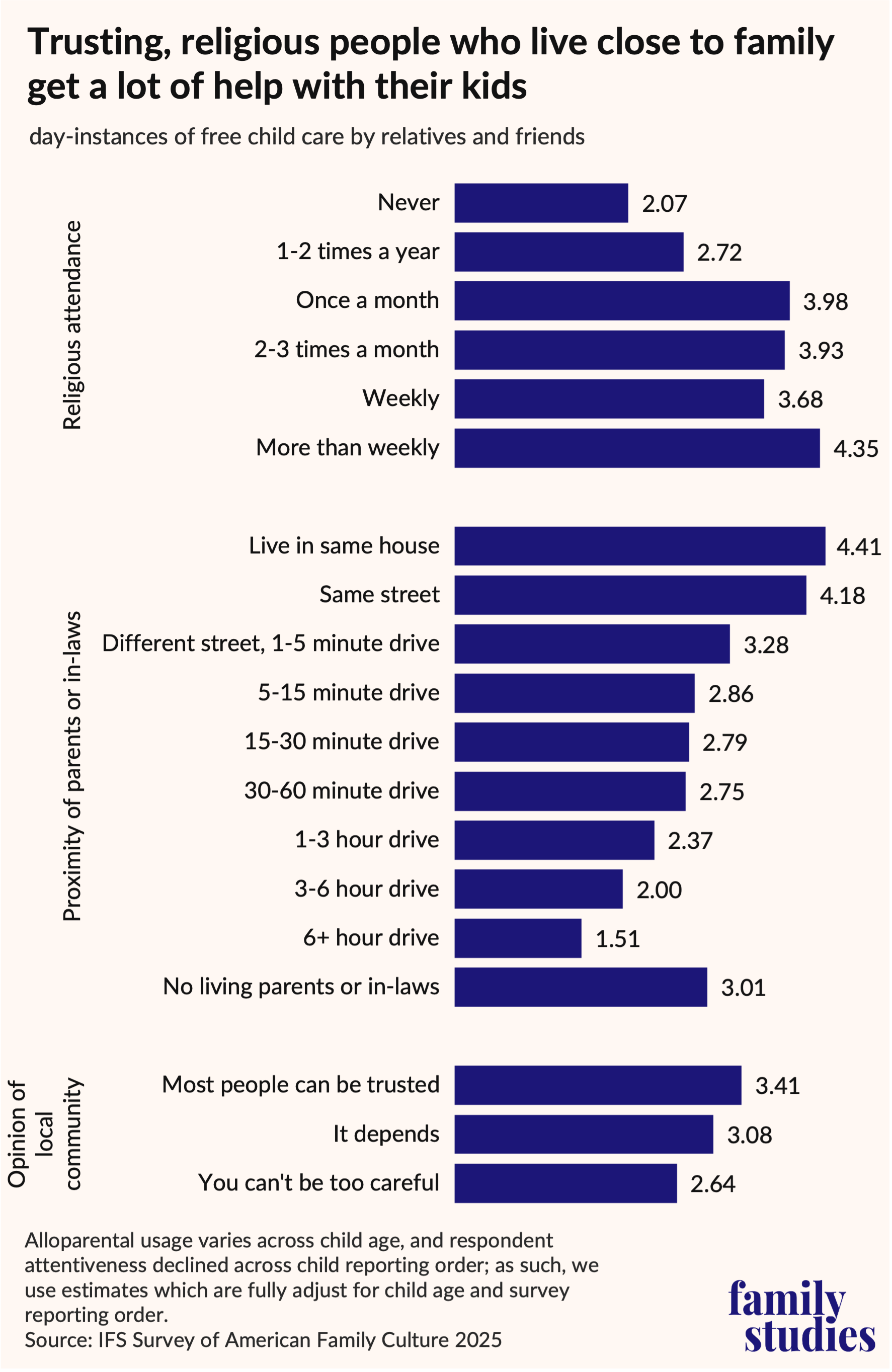
Religion clearly shapes the extent to which parents help each other, but so does proximity to family. Respondents who live closer to their parents or their spouse or partner’s parents get a lot more help: more than four instances a week of help when they live with or on the same street as their parents, vs. two or fewer instances if they live more than a three- hour drive from grandparents. Notably, this difference doesn’t run only through family care. People who live further from their parents get less help from friends too, probably because living further from parents often also means living further from lifelong friends and the kind of “family friends” who most naturally might provide alloparental help.3
Finally, trust in the local community matters, too: people who believe that most people in their local community can be trusted report receiving nearly an entire extra instance per week of help compared to those who believe “you can’t be too careful.”
So how does alloparenting relate to various experiences and outcomes of parenting? The relationship is profoundly mixed:
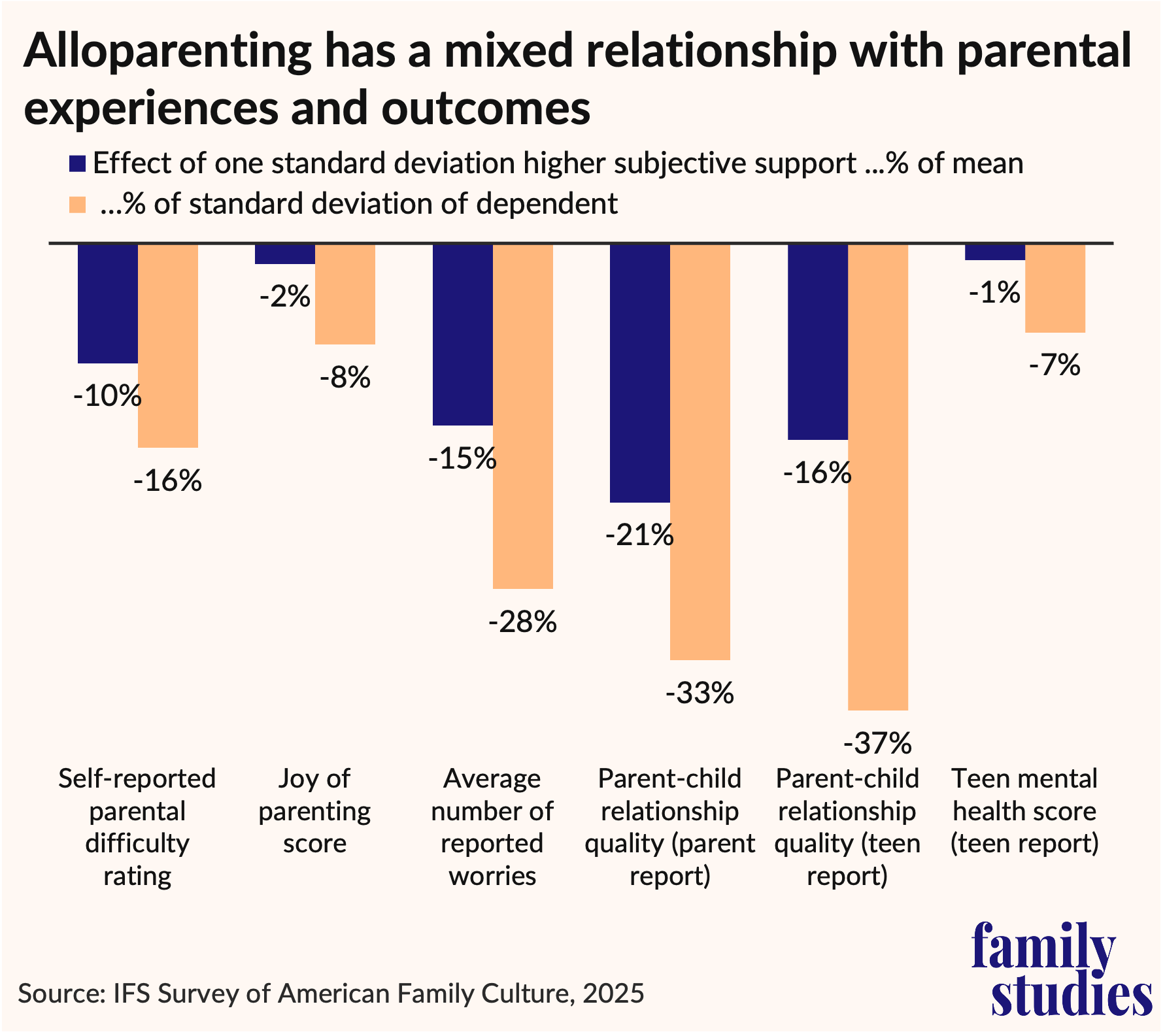
Parents who get more alloparental support report lower difficulty in parenting and fewer parenting worries. But they also report much worse parent-child relationships. Differences in enjoyment of parenting, and in a measure of teen mental health for teens we surveyed in those households, are fairly modest—but negative. In households where kids are watched cared for more often by non-household members, parents get a break, but it comes with a cost. Nor are these effects due to confounding based on why kids are being watched by non-household members: they are about the same even if we restrict to married households with supportive co-parents, religious households, wealthy households, or households with the happiest parents. These effects are similar for moms and dads, younger and older parents, and parents of different races.
The simple fact is that when kids are watched by friends and relatives, relationships with parents seem somewhat worse.
Child Care Help and Feeling Supported Aren’t the Same Thing
It may seem strange that the feeling of community support would have such positive associations with many outcomes of parenting, while a possible measure of community support has such mixed effects: shouldn’t receiving more help make someone feel more supported?
We saw earlier that parents who receive the most help and support are those with deeper local social ties, more trust in their neighbors, or more religiosity. The same is true for feelings of support: parents who felt more supported trusted their neighbors more. That might lead one to assume that people who get more actual free child care help feel more supported.
But that is not the case! High levels of feeling supported by one’s community are negatively correlated with actually receiving support, as the figure below shows.
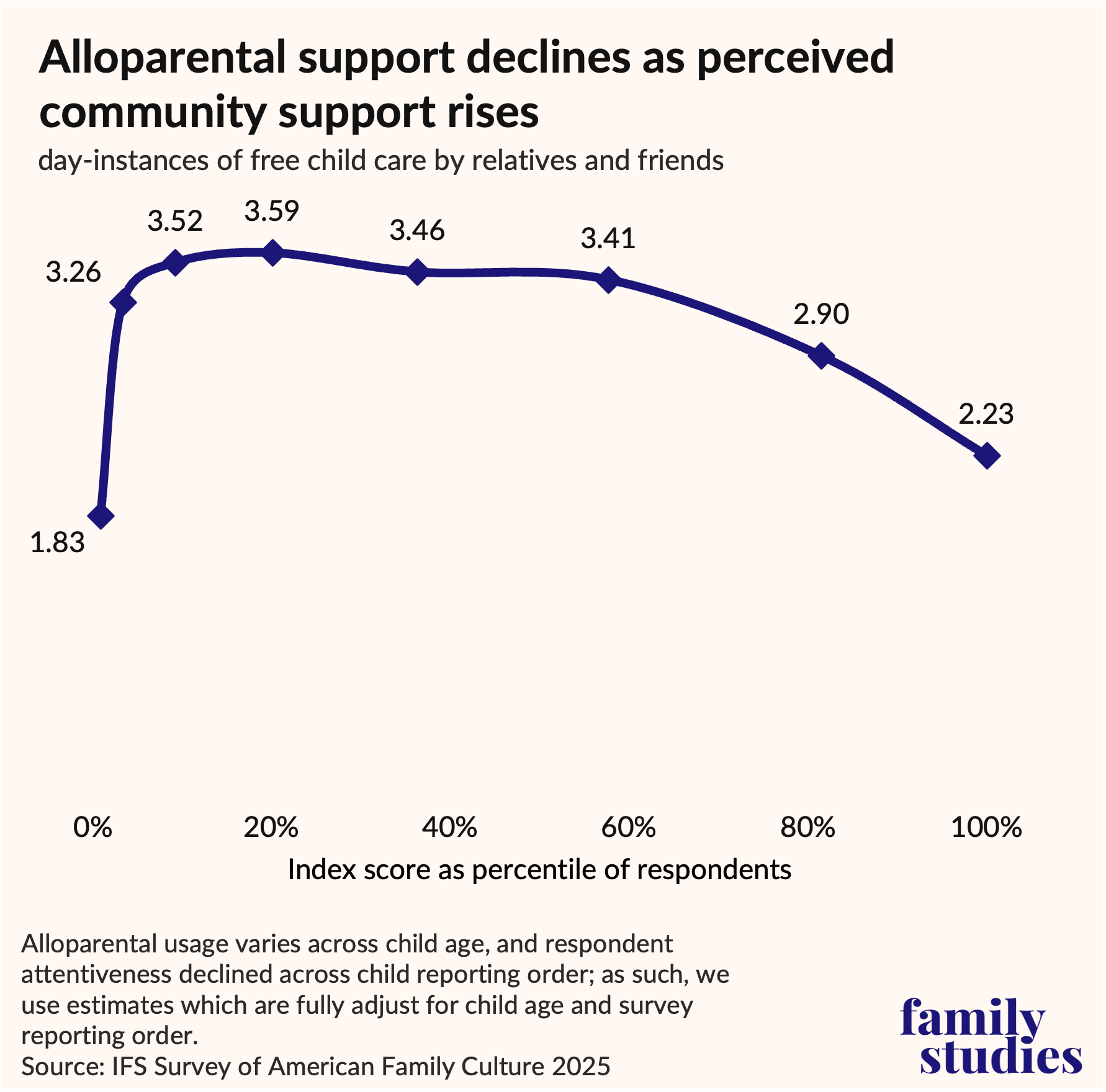
The highest alloparenting occurs among respondents around the 20th percentile of perceived community support, and then declines persistently. The people who feel the most supported by their communities are those leaning on them least.
Similar trends show up in terms of proximity to grandparents. Parents who live closer to their own parents or their in-laws have lower perceived community support, not higher.
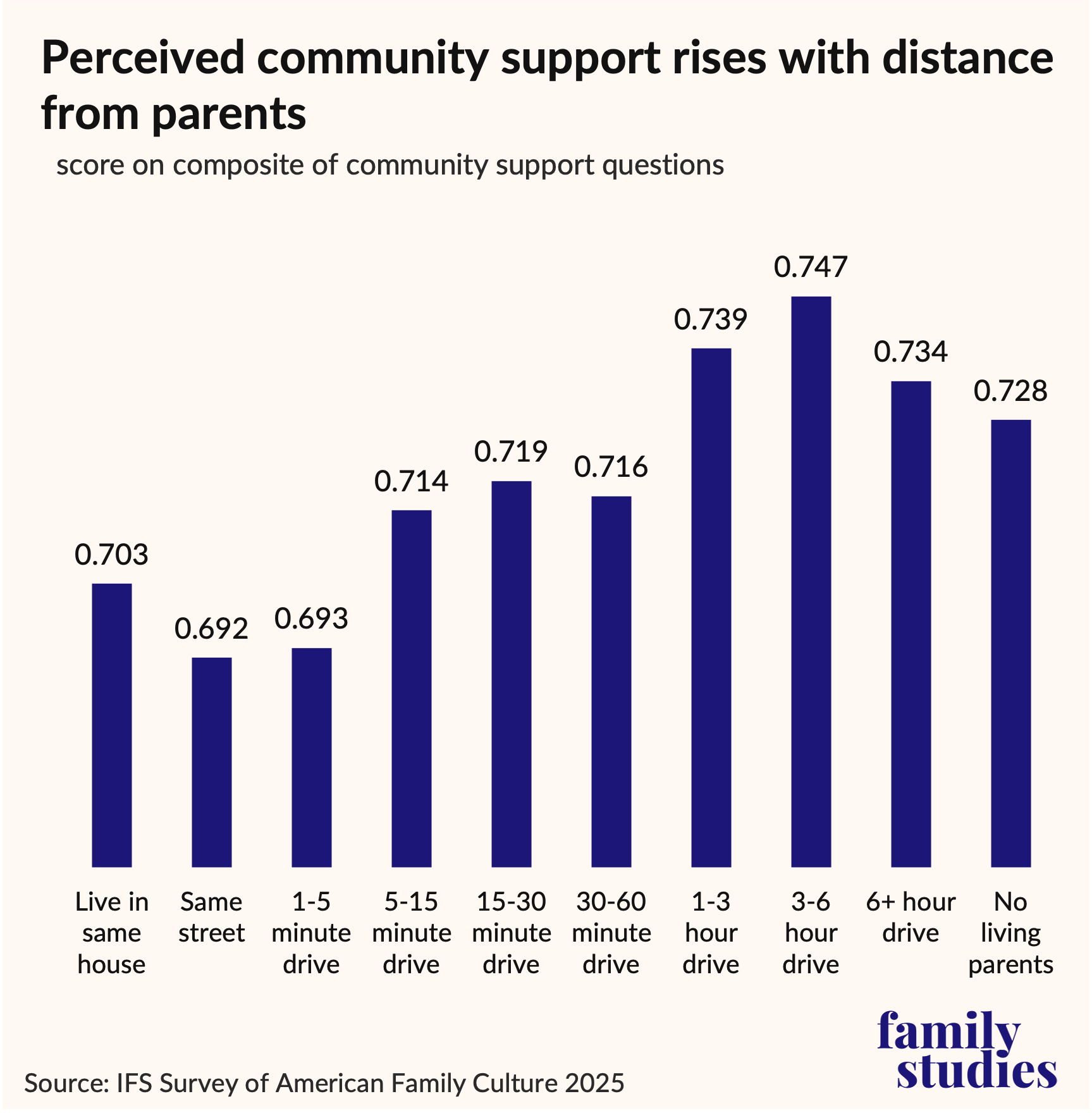
Our survey is limited in its ability to untangle all of these relationships, and we certainly can’t make firm causal conclusions from this data. In particular, we suspect the relationship between alloparental help and poorer parent-child relationships is due to some kind of residual confounding we were not able to fully untangle: high-achievers who move away from home into nice neighborhoods may feel good about their community, and have happy families, but also have thin local ties in terms of actual child care help, but we can’t test that kind of mobility dynamic due to limits in what we surveyed.
Nonetheless, one possible explanation jumps out—actual real-world community carries costs. If you let someone else watch your kids a lot, even grandparents, they might criticize some of your parenting choices. If you live close to your parents, they might give your child forbidden toys or forbidden snacks. In a world where people increasingly demand autonomy, and where social media rewards isolation, many peoples’ idea of community may simply be an echo-chamber.
Financial Stability Matters
Moreover, feelings of community support may have an entirely different origin: money. The average community support score rose persistently across income levels, from a low of 0.62 for households below $15,000 in income, to 0.76 for households above $200,000. For households where finances are getting much better, the average community support score was 0.74. For those for whose finances are getting much worse, the average score was 0.59. And for women with less than a high school diploma, the average support score was 0.6; for those with a graduate degree, it was 0.74
These results point to complementary explanations about what makes parents feel more supported in raising children. The education result suggests that higher socioeconomic status gives parents access to communities that make them feel more supported and less criticized. The recent-financial-change result suggests that an easier household budget has a similar effect. When parents have the budget space to go to the waterpark with other families, they feel better about their community. When they get to enjoy the fruits of being in high-functioning groups of parents, they probably also feel supported. But when budgets are tight, when the neighborhood isn’t safe at night, and when the park has used needles—then the community probably does not feel supportive, and no amount of free babysitting can change those facts.
Lyman Stone is a Senior Fellow and Director of the Pronatalism Initiative at the Institute for Family Studies.
*Photo credit: Shutterstock
1. If a grandparent watched a child for 30 minutes, then handed off to a neighbor for 30 minutes until dad got home at 6, that would count, in our data, as two days of care (1 day-episode by family, 1 day-episode by friends). This is a crude way of measuring care, but in an already-long survey, we could not collect detailed hourly data on every topic of interest.
2. We did not collect data for children over age 13 to limit survey length, and because our research team tends to be pretty free-range in our own personal parenting styles, and it didn’t occur to us how many families in America might believe that 13-year-olds still need babysitters: apparently enough that many 13-year-olds have babysitters several days a week after school.
3. Parents with no living parents or in-laws also get a lot of help; this is largely a product of statistical confounding, since these parents tended to be much older, and having young kids at an age where you need lots of help when you are old enough to have deceased parents is strongly associated with having higher educational attainment.


