
Highlights
- A majority of young adults today still endorse monogamy and only a fraction are involved in polyamorous relationships, per a new Wheatley Institute survey. Post This
- About 1-in-5 (21%) young adults who expect to marry say that they desire romantic relationships that do not require monogamy. Post This
Journalists and scholars continue to be intrigued by the practice of polyamory in modern relationships in which partners mutually agree to explore sexual and emotional unions with outside partners (sometimes called ethical nonmonogamy). We continue to see stories pop up in the news that explore these relationships from many different angles and with a focus on various demographic groups and nationalities. While much of the cultural conversation about sexually open relationships still reflects a positive bias, a broader range of views on this topic is starting to emerge, with many commentators raising questions and even doubts about the dynamics. Scholarly treatment of polyamory and other forms of consensual non-monogamy, however, seems unchanged, oddly leaning almost exclusively toward advocacy and seldom venturing into questioning.
Statistically, polyamorous relationships are still rare among currently married couples (by one estimate, only 1-4%). But some see that changing. What about the next cohort of marriages? After all, recent cohorts of young adults appear to be more open to the idea. For pro-marriage advocates, perhaps the most important group to monitor about these attitudes and behaviors is single adults who expect to marry. (About 85% of single young adults expect to marry one day.)
What does the next cohort of marrying couples think about monogamy and polyamory? And do their dating relationships reflect a weakening norm of monogamy and a heightened interest in alternatives? Or are more traditional sexual ethics still retaining their potency in our contemporary anything-goes culture?
5 Key Findings
We explored these questions with a nationally representative sample of young adults in their prime dating years (ages 22-35) in the 2025 National Dating Landscape Survey. Overall, we found that a strong majority of young adults today still endorse monogamy and only a fraction are involved in polyamorous relationships. Here are some of our major findings:
1. The proportion of young adults who currently engage in polyamory is small. Only 10% of young adults who expect to marry report that they are in a polyamorous relationship (7% of women, 13% of men). However, it is unclear how serious or committed these dating relationships are. While some may be committed open relationships, others may be less committed in nature with a “friends with benefits” type of relationship.
Sexual exclusivity remains the strong expectation and desire for most of today’s young women and men, especially if they expect to marry.
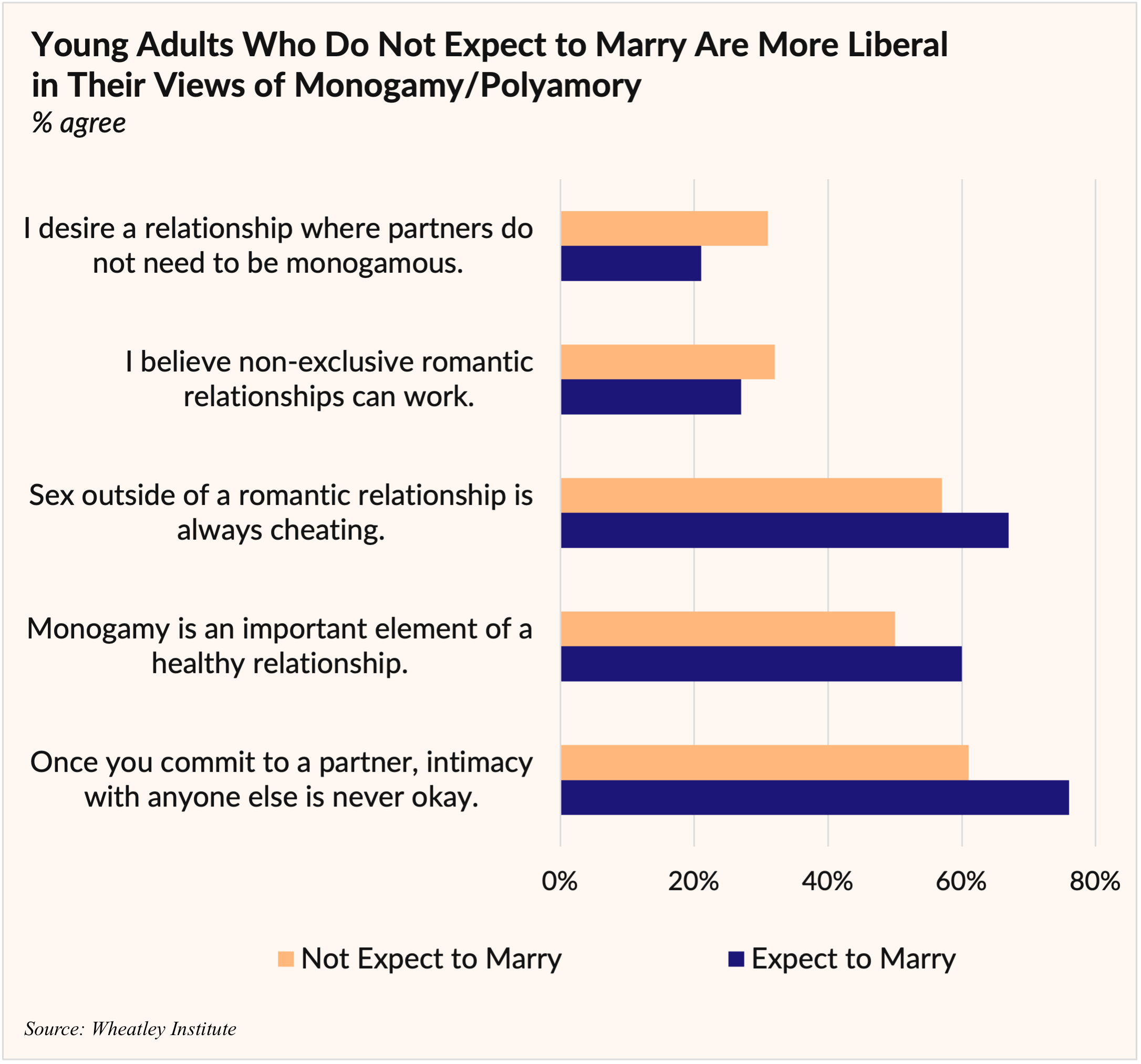
2. A non-trivial minority desire a non-monogamous relationship. About 1-in-5 (21%) young adults who expect to marry say that they desire romantic relationships that do not require monogamy. But our question did not ask specifically about polyamory in their future marriage, so it is unclear if this desire extends beyond the dating years. In the marital context, we expect this figure would be significantly lower.
3. Attitudes about monogamy still lean traditional. More than three-quarters (76%) of young adults who expect to marry agree that “Once you commit to a partner, intimacy with anyone else is never okay.” On the flip side, about a quarter of young adults believe that non-exclusive romantic relationships can work or that open relationships with more than two partners can be just as strong as any relationship.
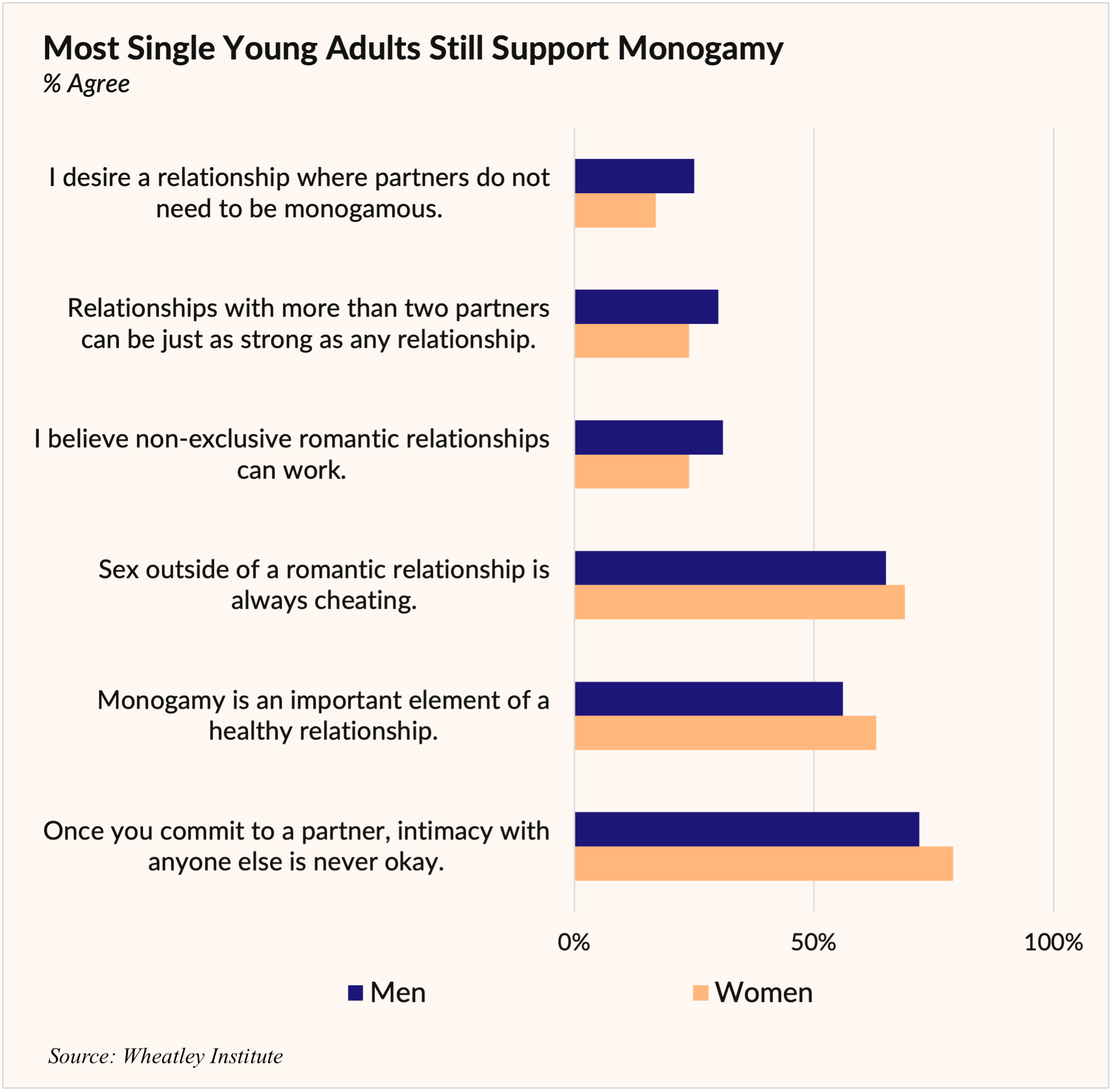
4. Young adult men and women who expect to marry are more similar than different in their attitudes about monogamy and polyamory. Although men are consistently a little more liberal, gender differences on these attitudes are small. Young adult men are 4-8 percentage points more liberal than women on these attitudes, but a solid majority still endorses monogamous relationships.
5. Young adults who do not expect to marry are significantly more liberal in their behavior and attitudes towards polyamory. Not surprisingly, nearly twice as many of those who do not expect to marry are currently engaged in a polyamorous relationship compared to those who do expect to marry (18% vs 10%). And 61% of those who do not expect to marry agree that “Once you commit to a partner, intimacy with anyone else is never okay,” compared to 76% of those who expect to marry. Still, even among those who feel untethered by future membership in the institution of marriage, progressive attitudes about consensual non-monogamy are still the minority.
Young adults today certainly are less judgmental of others’ sexual choices; polls about monogamy and various forms of consensual non-monogamy may reflect that general openness. And a significant minority of young adults (21%) who expect to marry say they desire non-monogamous relationships, at least before marriage. But few single young adults are involved in polyamory, and a majority expresses traditional attitudes about monogamy. Even amidst the digital din of popular media that celebrates the waning of monogamy and the scholarly advocacy questioning the modern value of it, sexual exclusivity remains the strong expectation and desire for most of today’s young women and men, especially if they expect to marry.
Nevertheless, a significant minority of young adults in their prime dating years like the idea of polyamory, and this number is large enough that it might complicate dating dynamics, making dating more difficult and stressful. Moreover, if this modest level of preference for non-monogamy carries over into marriage, it risks further deinstitutionalization of a foundational social institution. And it suggests that contemporary spouses may have to negotiate the meaning of this primary pillar of their marriage rather than assume it.
Alan J. Hawkins, PhD, is an affiliated scholar with the Wheatley Institute at Brigham Young University, a non-resident fellow with the Institute for Family Studies, and Chair of the Utah Marriage Commission. Brian J. Willoughby, PhD, is a professor and associate director of family life at Brigham Young University, a Fellow with the Wheatley Institute, and a Senior Fellow at the Institute for Family Studies. Jason S. Carroll is the Director of the Marriage and Family Initiative at the Wheatley Institute and a Senior Fellow at the Institute for Family Studies.
*Photo credit: Shutterstock


