Highlights
In a family therapy session that I (Jason) facilitated, Jeff was getting frustrated at his wife, Joni.1 “I know what I did was wrong,” he told her, his voice rising, and his finger pointing toward her face. “But I have been working really hard to make it up to you, and you need to be accountable and help me out!”
Joni became visibly upset. “You hurt me!” she said. “You lost your temper, lashed out with insults, threw the remote, and pushed me in front of the children.”
Jeff was annoyed and thought the issue had been discussed to death. “I am sorry, and I haven’t done anything like that for a year," he pointed out. "I feel like I’m doing all the work, and you can’t get past it. Can’t we just move on?”
When Betrayal Damages the Bond
Intimate relationships are a system, and all parties contribute to them. But as I explained to Jeff in that therapy session, betrayals are a shock to that system. When one person damages the other, the connection often needs intensive care and time to heal. This marriage had been rocked because Joni’s trust in Jeff and sense of safety had been harmed. Since that incident of verbal and physical aggression, every time Jeff escalated in tone or defensiveness, it scared Joni and aggravated her emotional wounds.
Flourishing couples repair missteps and resist impulses that trade short‑term relief for long‑term trust.
I explained to Jeff that every time he got impatient with Joni and demanded she trust him, it was like yelling at a flower to regrow after it has been stepped on. Not only is it impossible, but it adds another injury to the delicate recovery process. If he wanted to get to a healthier place in his relationship, he needed to focus on constant and caring commitment with his wife.
Commitment Builds Slowly, Betrayal Disrupts Quickly
Jeff and Joni’s experience reflect findings from recent research I have been conducting on healthy and unhealthy intimate relationships. Working with master’s student Megan Van Alfen, we examined how couples experience commitment and betrayal. We analyzed more than 80 in‑depth interviews with individuals who described experiences from their most meaningful connection to their most painful harms. Across interviews, commitment was consistently described as essential to relational bonds, while betrayals were described as damaging.
One of the key findings from this project was that commitment is often experienced as a gradual buildup of actions over time, like spending quality and quantity time with each other, and being loyal. On the opposite end of the spectrum were interactions described as betrayals, including infidelity, lying, or aggression, like what happened between Jeff and Joni. Betrayals were usually discrete events, and they damaged the growth created through sustained commitment.
Enduring Love Requires Active Protection
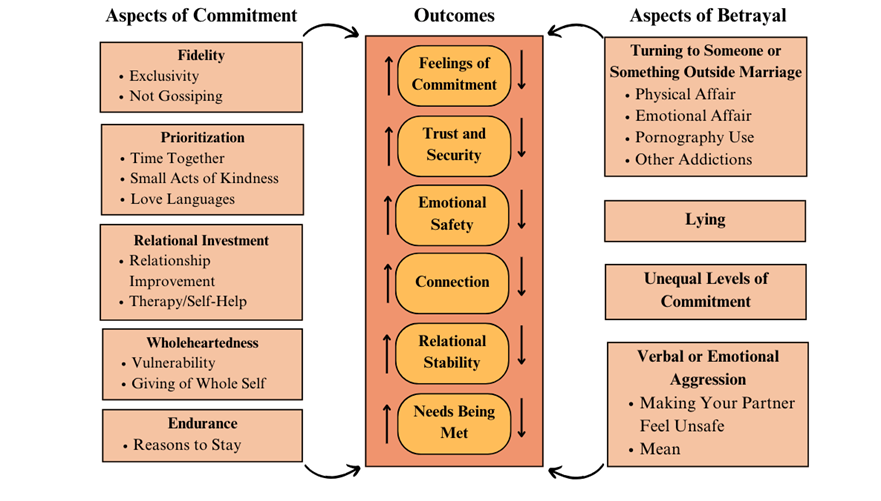
What we found in this research aligns with decades of relationship scholarship showing that enduring love does not automatically flourish but must be actively nurtured and protected. Healthy relationships require effort and prioritization, along with restraint from behaviors that damage. Across many studies, perceived partner commitment is one of the strongest predictors of relationship quality, satisfaction, and long‑term stability. Commitment fosters a sense of security that helps couples to weather the inevitable bumps and conflict that come when two lives become one, as the following graphic from our research shows:
Protecting a relationship does not mean avoiding conflict altogether but developing patterns of interaction that prevent relational injury. Couples who fare best are those who handle their differences with respect and patience. Flourishing couples repair missteps and resist impulses that trade short‑term relief for long‑term trust. When commitment functions this way, it allows partners to face challenges together rather than turning against one another.
5 Everyday Acts of Commitment
In our interviews, couples described everyday acts of commitment as a relational buffer, made of choices that helped them handle stress as a team rather than adversaries. They did not describe commitment as a vague feeling or a one‑time promise, but as a pattern of action expressed across five interrelated dimensions: 1) fidelity, 2) prioritization, 3) relational investment, 4) whole‑heartedness, and 5) endurance.
When people are disloyal, dishonest, or cruel, they undermine the foundation of safety and trust that close relationships are built upon.
Commitment included remaining loyal and honoring boundaries, placing the relationship high among demands, investing time and energy, showing up with sincerity, and persevering through difficulty. Commitment can be understood as a conscious, active decision to be dedicated to one’s partner and is expressed through words and actions. As one of the participants said: "We know that we’re there for each other. We know that there’s not anything that is going to tear us apart, that’s going to separate us from the marriage, the love that we have."
Betrayal Beyond Infidelity
Betrayal, by contrast, refers to actions that violate the integrity and expectations in intimate relationships. Participants identified several forms of betrayal, including 1) turning to someone or something outside of the relationship, such as affairs or addictions; 2) lying or deception; 3) unequal levels of commitment; and 4) aggression. While these behaviors varied in severity, they were consistently described as destabilizing.
What made these experiences feel like betrayals was not only what happened, but what was lost. Participants described an erosion of confidence in their partners as safe or as acting in the relationship’s best interest. Even behaviors that might appear minor or isolated from the outside often carried outsized weight because they violated core expectations. Betrayals often caused immediate pain, but also fractured the moral core of the relationship itself. When people are disloyal, dishonest, or cruel, they undermine the foundation of safety and trust that close relationships are built upon. One participant summarized this experience of violation: “He never hurt me physically. But he hurt my heart over and over and over again.”
Small Efforts Make a Big Difference
So, what does this mean for couples?
We live in a world that demands our time and attention, often leaving little energy for what matters most. Most people say their intimate relationships are their highest priorities, yet as life pulls them in multiple directions, those relationships can wither and even snap. The good news is that even small efforts matter. As our model shows, commitment builds safety and connection, and this is an ongoing decision and investment. With patience and care, a loving relationship can heal and thrive through commitment.
Jason B. Whiting, Ph.D., LMFT is a Professor of Marriage and Family Therapy at Brigham Young University. He researches deception, communication, and abuse in relationships and is the author of the book Love Me True: Overcoming the Surprising Ways We Deceive in Relationships (2016). For more information visit https://drjasonwhiting.carrd.co.
D. Scott Sibley, Ph.D., LMFT, CFLE is an Associate Professor in Human Development and Family Sciences in the School of Family and Consumer Sciences at Northern Illinois University. He researches commitment in couple relationships and romantic relationship formation. Learn more about Dr. Sibley and his research team at DecideToCommit.com.
*Photo credit: Shutterstock
1. Real names and identifying details have been changed to protect privacy.